

Developing and Maintaining Architectural Awareness Keeps You From Becoming an Artifact Spectator When Building With AI
Vibe Coding demands architectural awareness precisely because a successful build is not a reliable signal of correctness.

Guess what?
A single comment on a Substack Note I published yesterday triggered this post (in a good way).
How?
It started as a reply to a comment and expanded to over 500 words. So I decided to write it out and ping the commenter about this article.
It’s not as if I haven’t answered the question in my previous posts, but I felt I might not have made it any clearer or easier for non-techies to understand what I mean when I say that “having and maintaining architectural awareness” is essential when starting out to build with AI.
Looking back, I have been repeating the same mantra since I started this Substack on how to build with AI responsibly, Vibe Coding in particular.
Speak Dev.
Think like one in scaffolds, so you can develop and maintain architectural awareness of how modern software products are wired.
Those two ideas are not abstract slogans to me. They are the operating frame underneath nearly everything I advocate here.
Then, scaffold your build using the One Prompt Template and incrementally build your product with Composable Prompts.
And to assist you with that, I have created (more accurately, curated) two frameworks:
The Progressive Scaffolding Framework to support scaffolding your build’s user-facing side, and
The Simple Scaffolding Framework to provide a clear picture of the underlying primitives that underpin modern software products
Since I have hammered all of those angles - speaking Dev and thinking like one ( maintaining architectural awareness), I will not be taking your time going back on all the things I have covered so far.
So, what do I mean when I say “architectural awareness” is an essential skill when venturing into the new world of AI-assisted software creation, Vibe Coding in particular?
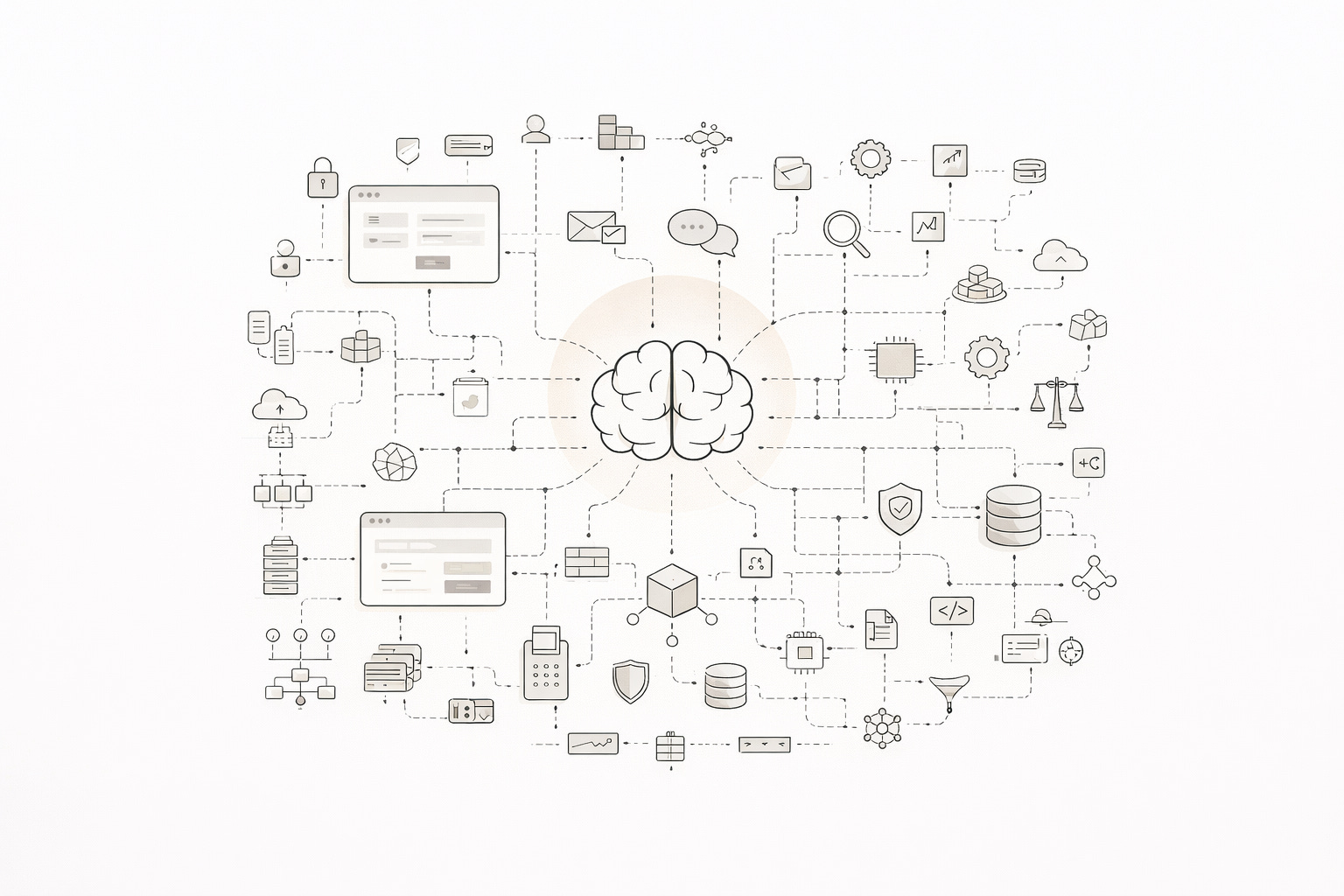
Having architectural awareness means maintaining a clear, shared understanding of your build, with LLMs powering the coding agents of the CodeGen platforms or the AI-assisted coding tools (IDEs and terminals) you use to build with AI.
Yes, the models are getting better, and the approaches used to harness them are evolving fast, riding the wave of model improvements, but having architectural awareness of your build is crucial, so your build can reflect the granular details of your nuanced requirements.
After all, trade-off decisions will only be made with a clear understanding of how your build might evolve, which influences how it should be scaffolded.
And that is where the real issue begins.
The problem is not whether the model can generate something functional.
The question is whether what it generated actually reflects your nuanced product requirements.
I argue that this applies whether you rely on CodeGen platforms with end-to-end vertical integration capabilities or on AI-assisted integrated coding tools - IDEs (including terminal-based ones) - that are more geared towards reimagining traditional development workflows with LLMs.
Suppose you start your next project by doing the frontend part on Aura or v0 and then want to move the next phase of your build to CodeGen platforms (Lovable, Bolt, Replit, or any of the others that have flooded the market since last year).
If you can’t identify the underlying components that make up your build, how they should be wired, and how they connect to each other, your build will end up being a vibeslop that the involved models consider fitting based on their training dataset and the context the models have managed to hold onto long enough from your initial build plan.
Let’s view it from two different levels of builder experience.
For non-techie builders of CodeGen platforms, and for techies (add the adventurous non-techies as well), using AI-assisted coding tools, including terminal-based coding agents like Claude Code (Codex is now more than just a terminal-based coding agent).
For non-techies, even though the CodeGen platforms handle most of the wiring, it’s essential to have a say in the type of tech stack your build should rely on within the limited offerings (including the vertically integrated ones).
Because your early decisions (mostly made unknowingly) are the ones that will later come back to haunt you or the traditional developers you bring on board, especially if your product attracts more users than you expected.
Even with Connectors now accessible via MCPs on most CodeGen platforms, including Lovable, Bolt, and Replit (the awkward middle in the Vibe Coding app space), it remains crucial to carefully consider what to include and for what purpose.
Everything in your build should be known to you.
You should tell why it is there.
For what purpose?
After all, you will bear the cost of maintaining it or having it maintained in the future, even if refactoring (reimagining how your build should be scaffolded) is out of the question anytime soon.
This is where architectural awareness stops being a nice catchy phrase with an abstract idea and becomes a practical discipline. It shows up in the questions you can ask before the LLMs powering the coding agents quietly answer them for you.
What exactly makes up your build beneath the surface-level interface?
Which parts of it are handled by the platform, and which responsibilities still belong to you?
And how do the choices you make across those moving parts affect the reliability, cost, security, scalability, and future evolution of your product?
You must be able to answer questions like:
Do you rely on the build-it database they offer, or prefer a dedicated database service provider?
Which authentication provider do you choose based on your potential client, enterprise or individual customers-to-be?
Do you rely only on the web services they provide via their platform, or do you go directly to the service provider using their APIs?
How do you put a rate limit on an AI inference if features in your app depend on LLMs?
Where do you store user-uploaded files, and how?
How do you intend to make access to data so fast?
How do you intend to make it easier to scale every aspect of your backend in case more users land on your products concurrently?
Where do you deploy, and how do you plan to streamline your deployment flow in case you choose not to rely on the CodeGen platform’s deployment offerings?
Those are only surface signals.
Architectural awareness really begins when you can see the major thematic layers and primitives that make up modern software products clearly, and understand how each one shapes what your build can do, how it behaves under pressure, what it costs to maintain, how secure it is, and how easily it can evolve.
Architectural awareness proves useful at every turn.
And that understanding only comes when you can see the major layers and primitives that make up modern software products clearly, and understand how each one shapes what your build can do, how it behaves under pressure, what it costs to maintain, how secure it is, and how easily it can evolve.
At a high level, those responsibilities tend to cluster around a few major buckets:
1. User-facing product surfaces
These are the parts the user directly experiences or triggers.
UI screens
Authentication and account access
Messaging and notifications
Search
Payments and billing
File upload and retrieval
2. Core application and business logic
This is where the product’s actual behavior gets implemented.
API layer
Business logic services
Background workers and scheduled jobs
State management
Internal admin flows and operational controls
3. Data and storage layer
This is about where data lives, how it moves, and how fast it is accessed.
Database
Object storage / file storage
Caching
Queues and event streams
Data pipelines
Search indexing
Analytics data flow
Object storage vs database distinction
4. Infrastructure and delivery layer
This is the runtime environment that carries the product.
Compute / runtime
Containers and orchestration
Networking
Load balancing
CDN / edge
Deployment environments
5. Integration layer
This is where your product touches external systems.
Third-party APIs
Webhooks
Identity providers
External service connectors
API gateway / integration node
6. LLM-powered features
This is the part of your product that relies on LLM APIs to generate responses, process input, retrieve context, or power AI-driven features.
Inference pipeline
Prompt assembly
Model selection and routing
Context retrieval and retention
Vector databases
Guardrails
Output validation
Rate limits and usage controls
7. Observability and operational control
This is how you keep the system understandable and maintainable after it is live.
Logging
Monitoring
Tracing
Feature flags
CI/CD
Incident response hooks
Audit trails
8. Cross-cutting trust, risk, and protection concerns
These are not one box in the system. They cut across all boxes.
Security
Authorization and permissions
Privacy and data handling
Rate limits and abuse prevention
Reliability and failure handling
Cost controls
That is, even if you are building with CodeGen platforms. The stakes rise further once you leave the managed comfort of CodeGen platforms and start building inside more open-ended coding environments.
Having architectural awareness becomes more important if you rely on AI-assisted integrated coding environments - IDEs and terminal-based coding agents.
From the type of framework (skeletons of modern software builds) you choose to scaffold your build to the libraries (pre-written, reusable, modular implementations of functionalities that are commonly used in countless projects, so you do not have to recreate everything) you rely on to develop the different features that make up your build, the need for architectural awareness becomes more evident.
With such skill under your belt, you can easily break down the implementation of your product’s business logic into manageable modular blocks of code, giving you detailed control over each part rather than consolidating all your logic into a single monolithic codebase.
This can be beneficial, particularly given the limitations of coding agents when managing multiple business logic implementations simultaneously.
This facilitates working on individual parts of your build sequentially with verifiable test loops, avoiding the nightmare of untangling monolithic implementation.
All of this can be a smooth experience if you focus on developing and maintaining architectural awareness of how modern software products are wired, and understanding the primitives that hold modern software together can be be very useful here.
The "artifact spectator" framing is spot on. I see the same problem from the other direction. Experienced developers can fall into it too, just differently. Instead of not knowing the architecture, they know it so well they stop checking whether the AI is respecting it. Context drifts and they don't catch it because they assumed the model held the same mental map they did.
The official best practices guide calls this "the trust-then-verify gap." You let the agent run for 20 minutes, then discover it went off course 18 minutes ago. Your scaffolding framework would actually help here because it gives both the human and the AI a shared vocabulary for what's expected. Covered this and the other common failure patterns here https://reading.sh/context-is-the-new-skill-lessons-from-the-claude-code-best-practices-guide-3d27c2b2f1d8?postPublishedType=repub
Do you find your non-techie readers actually maintain the architectural awareness long-term, or does it tend to fade once the first build is running?
Great post. But the answer to the question that triggered the post is then.. "everywhere!"
I think we need to make it easier for the "non-techies" to take their MVP from 80% (vibe coding) to 90% (shipped app that's safe from the largest pitfalls)?
I look forward to your reply in another article 🙃 (just kidding, up to you ofc!), thanks for this interesting take of yours.