Vibe Coding Isn’t the Problem. It’s the Lack of a Baseline.
Yes, the web is filling with vibeslop. But Vibe Coding is staying. So what literacy keeps new builders from shipping slop by default?

This post started as a Substack Note and ended up longer than I planned. So here it is.
Here’s the TL;DR:
Vibe Coding isn’t the problem.
The problem is the missing baseline literacy and guardrails that would let millions of newcomers build responsibly.
Until that floor exists, the ecosystem will keep oscillating between functional software and slopware.
I see many comments dismissing Vibe Coding from the outset.
As if it were a spicy sauce that kindles virality.
For some, it has worked.
I never bothered to take the time to respond to every comment from Subsack, Twitter or Reddit, with a reflection on my experience of vibe-coding so far, both on personal projects and in my research for this Substack, Vibe Coding with AI.

I do not want you to take this as a defence of Vibe Coding.
This note by one of my favorite Substack comrades captures what I feel about Vibe coding:
I share the view that a flood of vibeslop is taking over the web, app stores, and, in recent weeks, code repositories, including open-source software repositories.
AI-generated code as contributions is hammering maintainers so hard.
Even more, AI agents are on a PR spree.
It is getting wild, wild, wild cyberspace.
A volunteer maintainer for matplotlib, Python’s go-to plotting library, has shared his horrifying experience after being shamed by an AI agent that tried to get his contribution accepted.

However, when it comes to Vibe Coding, the one thing most seem to ignore is:
Vibe Coding was defined by a practitioner with nearly two decades of programming experience.
He wasn’t thinking about non-techies embracing this new AI-assisted software development method.
It was just a shower thought.

"I'm told that this is now like a major meme … fun story about this is that I've been on Twitter for like 15 years or something like that at this point and I still have no clue which tweet will become viral and which tweet like fizzles and no one cares and I thought that this tweet was going to be the latter I don't know it was just like a shower of thoughts but this became like a total meme and I really just can't tell but I guess like it struck a chord and it gave a name to something that everyone was feeling but couldn't quite say in words"
Andrej Karpathy
Indeed, it gave a name to something everyone was feeling but couldn’t quite put into words.
Yes, even those who are selling the shovels and do vibe-code do not like the term:
“Well I I’ve learned through my times in the valley is not to fight the hype... like I remember when cloud was controversial A lot of people hated a cloud but just stuck around right so so although I have feelings about it I we we kind of embrace it in many ways.”
Amjad Masad, the CEO of Replit.
OpenClaw creator, Peter Steinberger, called it a “slur”, during his latest conversation with Lex.
“First of all, I don’t like the term Vibe Coding ... I tell people ... what I do is agending engineering with a little star. He suggests that “Vibe Coding” is a phase that begins late at night (3:00 a.m.) when the “mundane stuff of writing code is automated away”.
Peter Steinberger
But remember, for a practitioner, giving in to the vibes comes naturally. Whatever “giving in to the vibes” means.
Beyond just adjusting the padding on a UI component.
Fortunately or unfortunately, it turns out the non-technical community embraced it.
Big time.
Through trial and error, which has at times been costly to the larger ecosystem, the Internet.
Industry insiders, including Karpathy, are warning that we should brace for the coming “slopacolypse”.

And it still is.
Despite the models’ improvement.
Despite the vertical integration spree, CodeGen platforms have continued to advance, reducing their reliance on these stochastic models, particularly when integrating the various building blocks that make up modern software.
Remember the initial Will Smith pasta video?
Have you seen the models’ evolution since then?

Coding models are also advancing to incorporate features that better empower non-techies without requiring them to grapple with the more complex aspects of building software.
Various agentic harness approaches are being implemented by the developers of CodeGen platforms and AI-assisted coding tools, leveraging model improvements and guardrails so that even those with no coding experience can navigate the build process unscathed.
Yes, the models will remain non-deterministic.
But we are finding more ways to produce deterministic outputs by putting different harnessing capabilities around these probabilistic systems.
Some even go so far as to say that without knowing how to code, Vibe Coding will only lead to slop.
In my humble, subtly blunt opinion, practitioners should not discourage those without a technical background whenever we encounter them, simply because they are struggling to find their way in this new world.
And no, they do not need to learn about Big O notation.
Vibe Coding is here to stay.
Period.
That argument has been won.
That is the consensus among the very people working on the very tech stack that is making Vibe Coding increasingly effortless and safe end-to-end, some of whom even dislike the very term Vibe Coding.
You should know not to fight a trend that is destined to be synonymous with software creation, which will be dominated by non-techies far more than by traditional developers who have been practicing this craft for decades.
Vibe Coding promises to expand inclusion from over 30 million developers to 300 million builders, and eventually to 1 billion creators.
Imagine a world where everyone is a builder, if not a programmer, building “software for one” and, for the adventurous, “productizing themselves” with software now that English is the trendiest programming language.
Non-techies can do all this using many CodeGen platforms that are democratizing the craft of software development through good old natural language.
The developers behind the platforms are working on end-to-end build workflow handling, from prototyping and wireframing a minimum viable product to taking your build live in a streamlined way.
The CodeGen platforms and the “awkward middle”—Replit—are going a long way toward building and harnessing features that streamline building with AI. This is not to say we are there yet.
And for the adventurous non-techies who want to get their feet wet and even go all in on AI-assisted coding tools, that is even more empowering.
That is when learning to code comes in handy.
I would say the “awkward middle” Replit can be viable in this transition.
Replit gives you a sense of what to expect from AI-assisted coding tools and the integrated development environments (IDEs) that are being infused with AI at a rapid pace over the past couple of years.
When you are ready to hatch out of the sandbox of CodeGen platforms and into the world of AI-assisted coding tools, IDEs, or command-line coding agents, you should start learning to code.
What is great about the zeitgeist we find ourselves in is that this time, the good old way of learning to code is no longer the norm.
You don’t need to memorize syntax in your head any longer.
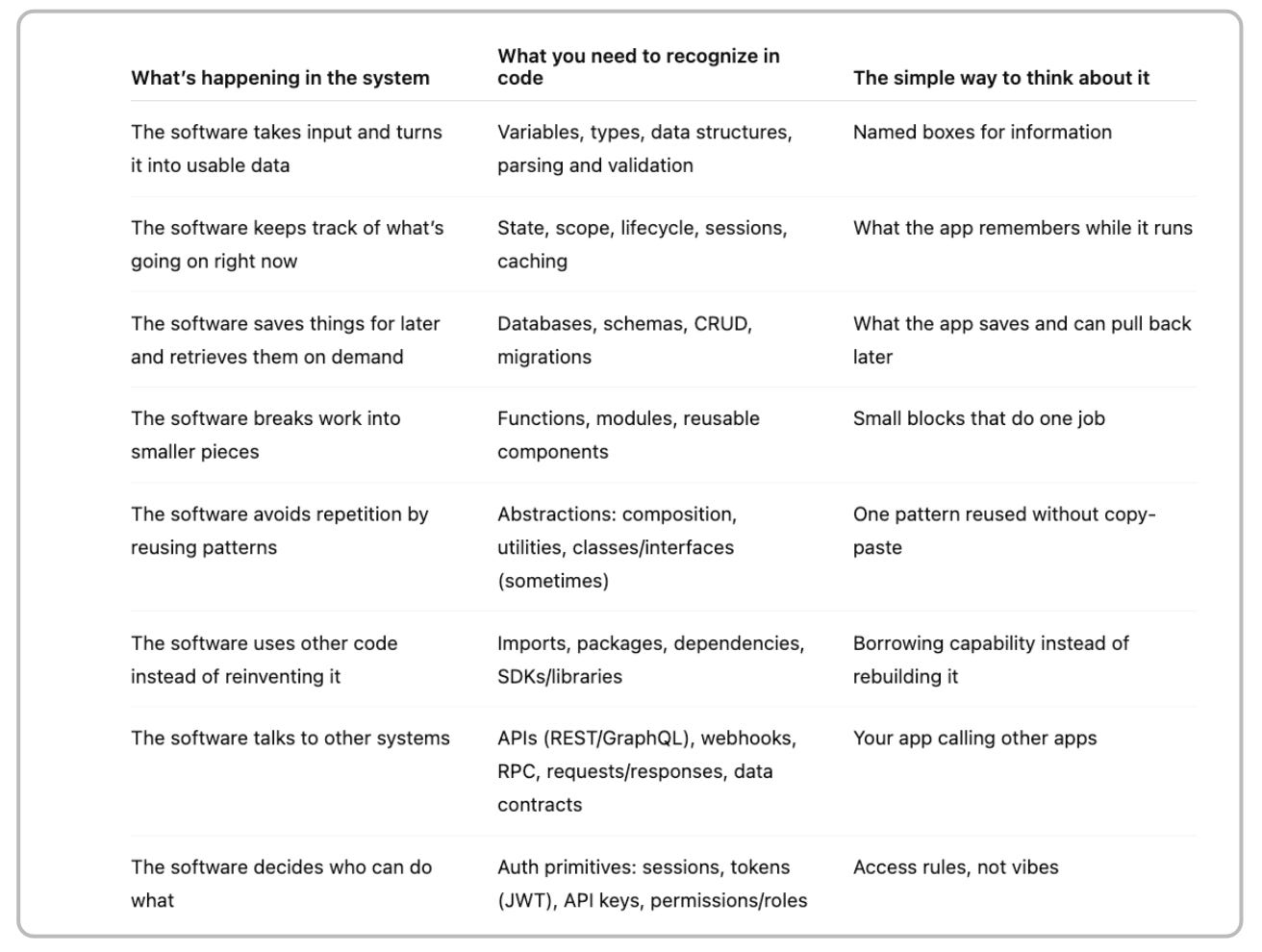
What you need instead is a mental model of how code components are structured, not the old habit of memorizing every special character of syntax.
Learning how computers memorize input, handle on-the-fly memory and permanent storage, connect to another codebase, reference an integration path to an external service, secure connections, and more subtle details that go beyond writing code to decoding the substrates that make up a software product that is secure, efficient, scalable, and sustainable.
And for those who want to work within the sandbox offered by CodeGen platforms, foundational literacies should be lowered below learning to code.
Until they decide to graduate from CodeGen platforms, I say let them vibe with code to their hearts’ content without shaming them into learning to code.
Then the next question should be what kind of minimal entry-point literacy should be in place so we do not end up in “slopacolypse.”
What kind of guardrails should there be to ensure that the million more people onboarding into the new world of building with AI do so responsibly?
Dropping a tweet, a Substack Note, a Reddit post or a LinkedIn article trashing these new approaches to software creation without taking the time to consider the potential these LLM-powered software creation platforms and tools bring to those who have never imagined they would create software for lack of coding literacy is not an intellectually based position grounded in facts.
I would say it’s sheer desperation to gain traction by riding a trendy topic that was deemed dead yet keeps striking back with every model improvement.
Vibe Coding was coined by a veteran - a shower thought encapsulated in two words - and adopted by non-techies at scale.
Now we need the baseline literacy that makes the ecosystem survivable.