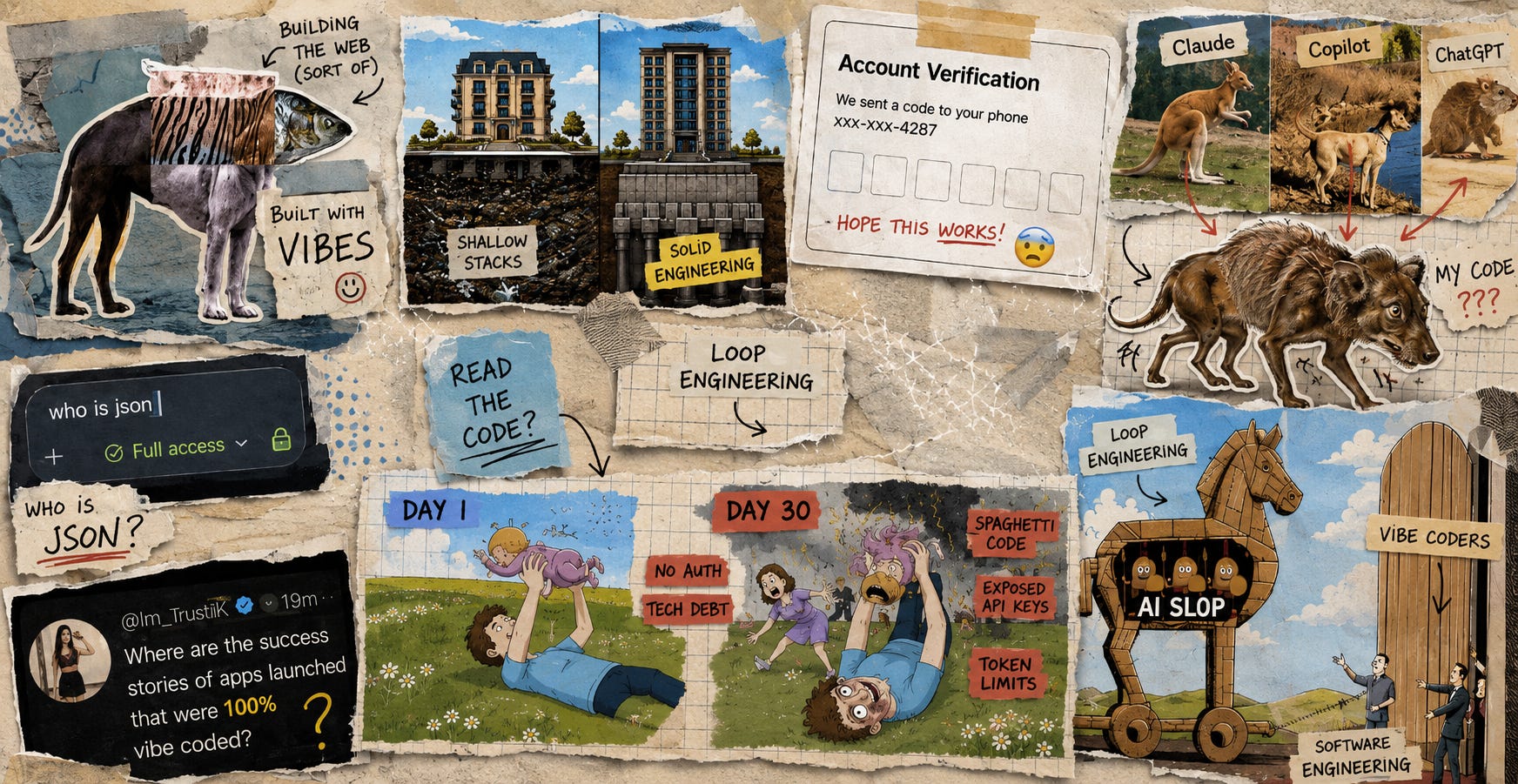
Why Vibe Coding Memes Are Becoming Stale, Even When Their Warnings Still Hold
Some of the memes about what models and harnesses cannot do are aging fast. The warnings about what builders still do not understand are not.

tl;dr: Yes. Parts of memes that target Vibe Coding and poke fun at those who embraced this new way of building with AI are becoming stale. Fast. But not every part, and not every meme. Some still make sense, while more of them are sloppier than most Vibe-Coded apps, yet with sarcastic flair. There is a reason for that. This is in defence of the normies. I will defend you from the memes that poke fun at you for stumbling due to the limitations of model capabilities, their stochastic nature (funny but not funny), and the limitations of today’s experimental harnesses any day of the week. But what I cannot do is defend you from the memes that make fun of you for not taking the time to learn the foundational literacies.
There is a huge disconnect in the LLM-powered AI space, still in its early forming phase, around what has transpired over the last couple of years, even the recent months, particularly in AI-assisted software creation, in particular Vibe Coding.
It all comes down to the following.
Most seem to forget, or even have no clue, that Vibe Coding was only meant to be a shower-thought tweet targeted at the dev community, which makes up most of the audience of Karpathy, the AI researcher who coined the term eighteen months and one week ago to the day.

At about the same time, LLMs were starting to power more and more tools that made it almost effortless to generate code, the core building block used to create software.
Making it possible for anyone to build software products using natural language without having to learn coding syntax.
That has opened the gate.
Letting Vibe Coding gain traction beyond the dev community. Bringing millions into the craft that was once reserved for those who learned to code.
Millions more without any foundational literacy jumped on the opportunity. Eager to build the one tool, the one product, the idea they wished had already been built. The person they had dreamed would build the one product that could solve the one pain point they had always lived with turned out to be themselves overnight.
The speed at which things were changing led to pushback from traditional devs who had lived through different eras of abstraction.
The most obvious pushback came from the desire to save the ecosystem from Vibeslop generated by normies who “gave in to the vibes” without any idea of the consequences of their actions, at a time when the models and the guardrails around them could barely deliver a well-scaffolded build without jumbling the abstractions of the primitives that make up modern software.
A build that remains fairly maintainable. Most importantly, one that does not end up becoming a honeypot for attackers because of security loopholes.
Here is what the team behind Devin and, later, Windsurf, the Cognition Team, had to say about it:
We feel that the popular usage of “vibe coding” has strayed far from the original intent, into a blanket endorsement of plowing through any and all AI generated code slop.
If you look at the difference between the most productive vs the problematic AI-assisted coders, the productive ones can surf the vibes of code that they understand well, whereas people get into trouble when the code they generate and maintain starts to outstrip their ability to understand it.
That is what distinctly separates Vibe Coding done by a normie without foundational literacy about how modern software products get wired from Vibe Coding done by a traditional developer.
For a traditional developer working with LLM-powered coding agents, “giving in to the vibes” comes naturally.
Well, Guess Who Has Been Vibe Coding Lately?

In the early days of the conception of the latest software development paradigm, Vibe Coding, traditional developers frowned upon it.
Traditional devs can tell what is what.
Can tell how abstractions for the different primitives that make up modern software products are wired.
They know which tech stack to consider for each type of business logic requirement they face.
If the need to align a particular component on the user interface by a little bit, you know how to Speak Dev well enough to articulate exactly what you want.
The disconnect started to form the moment people without a technical background, the ability to speak a fair amount of dev and design lingo, or any idea of how software products get wired these days came into the picture and started to “give in to the vibes.”
Karpathy probably had not anticipated that. After all, it was just a shower thought. I am not sure anyone anticipated that.
How could he have known?
"… fun story about this is that I've been on Twitter for like 15 years or something like that at this point and I still have no clue which tweet will become viral and which tweet like fizzles and no one cares and I thought that this tweet was going to be the latter …. I don't know it was just like a shower of thoughts but this became like a total meme and I really just can't tell but I guess like it struck a chord and it gave a name to something that everyone was feeling but couldn't quite say in words".
The thing is, the content creator crowd picked it up, and the rest is history.
I am from the welcoming camp.
The LLMs have raised the floor. That is a good thing.
So are many of the vocal voices in the industry, I would say, if you ignore the Reddit crowd.
I love and hate Reddit.
Who Gets to Build? The Cultural and Technical Tensions Behind the Vibe Coding Backlash

If you’ve spent any time on Reddit, you already know how fast a simple post can turn into a battlefield.
But right after the tsunami of normies embracing this new way of software creation, traditional devs (I refrain from calling them gatekeepers anymore) started devising ways to make distinctions. The leveling of the floor vs preserving the engineering rigor of the past.
Andrej Karpathy discusses the difference between Vibe Coding and Agentic Engineering as follows:
... I would say Vibe Coding is about raising the floor for everyone in terms of what they can do in software.... everyone can vibe code anything and that’s amazing incredible but then I would say Agentic Engineering is about preserving the quality bar of what existed before in professional software so you’re not allowed to introduce vulnerabilities due to Vibe Coding ...
... you’re still responsible for your software just as before but can you go faster and spoiler is you can but how do that properly and so to me Agentic Engineering when I call it that because I do think it’s kind of like an engineering discipline you have these agents which are these like spiky entities they’re a bit fable a little bit stocastic but they are extremely powerful....

Karpathy's definition of Agentic Engineering earlier this year:
The one thing I'd add is that at the time, LLM capability was low enough that you'd mostly use vibe coding for fun throwaway projects, demos and explorations. It was good fun and it almost worked.
Today (1 year later), programming via LLM agents is increasingly becoming a default workflow for professionals, except with more oversight and scrutiny.
The goal is to claim the leverage from the use of agents but without any compromise on the quality of the software.
Many people have tried to come up with a better name for this to differentiate it from vibe coding, personally my current favorite "agentic engineering":
"agentic" because the new default is that you are not writing the code directly 99% of the time, you are orchestrating agents who do and acting as oversight.
“engineering” to emphasize that there is an art & science and expertise to it. It’s something you can learn and become better at, with its own depth of a different kind.
In 2026, we're likely to see continued improvements on both the model layer and the new agent layer. I feel excited about the product of the two and another year of progress.
He did make the right prediction. Models have gotten better, and the “new agent layer” he predicted began to take shape in harnesses, while at the same time many started to distance themselves from Vibe Coding.
Veterans in the industry like Simon Willison proposed Vibe Engineering, then retired it when Agentic Engineering started getting traction with more and more traditional devs:
I feel like vibe coding is pretty well established now …. loose and irresponsible way of building software with AI—entirely prompt-driven, and with no attention paid to how the code actually works.
This leaves us with a terminology gap: what should we call the other end of the spectrum, where seasoned professionals accelerate their work with LLMs while staying proudly and confidently accountable for the software they produce?
I propose we call this vibe engineering, with my tongue only partially in my cheek.
Peter Steinberger, the creator of OpenClaw, has tried to distance his AI-driven workflow for building from the term Vibe Coding, even though his approach pretty much resembles what the term Vibe Coding encapsulates.
Here is what Peter had to say about Vibe Coding during his long conversation with Lex Fridman:
"I do agentic engineering and then maybe after 3:00 a.m I switch to Vibe Coding and then I have regrets on the next day … walk of shame … you just have to clean up and like fix your shit. We've all been there"
That was all before the whole “do you look at the generated code or not?” debate flared up on X among some of the most vocal people in the industry.

In March 2025, Simon Willison made his case for a distinction that was needed, and still needs to be made, in a post titled “Not all AI-assisted programming is vibe coding (but vibe coding rocks)”.
Come 2026, following the release of more and more capable models and experimental attempts to circumvent their shortcomings, the distinctive characteristics anyone could list between what we have come to consider Vibe Coding and the rest of the AI-assisted software creation category (Agentic Engineering, Vibe Engineering, or anything else) started to blur.
The space is shifting so fast that they are starting to overlap. But the overlap is more pronounced when they are being practiced by traditional devs.
X Conversations Capturing the Zeitgeist: Re-Conceptualizing How We Build with AI

Indeed, we are past the point of dismissing the very AI-induced zeitgeist we find ourselves in.
Just four months ago, Simon had to revisit that fading distinction on Heavybit’s High Leverage podcast in conversation with Joseph Ruscio, “Ep. #9, The AI Coding Paradigm Shift with Simon Willison”.
“Weirdly though, those things have started to blur for me already, which is quite upsetting.”

As coding agents became more reliable, he said, he stopped reviewing every line coding agents generate, even for production work.
His confidence did not come from vibes alone.
No.
Even if it comes naturally to such traditional developers to “give in to the vibes”. After all, the very person who coined the term and first entertained his shower thought is also a traditional developer with decades under his belt in programming, while also being one of the luminaries of the AI research space.
Simon’s confidence came from 25 years of experience, plus automating engineering rigor and knowing which tasks were straightforward enough to delegate without having to hand-hold the agents at every step.
For a non-techie, that is a completely different story. But this is where the next meme lands. Foundational literacy is not optional. Without it, you will surely get lost.
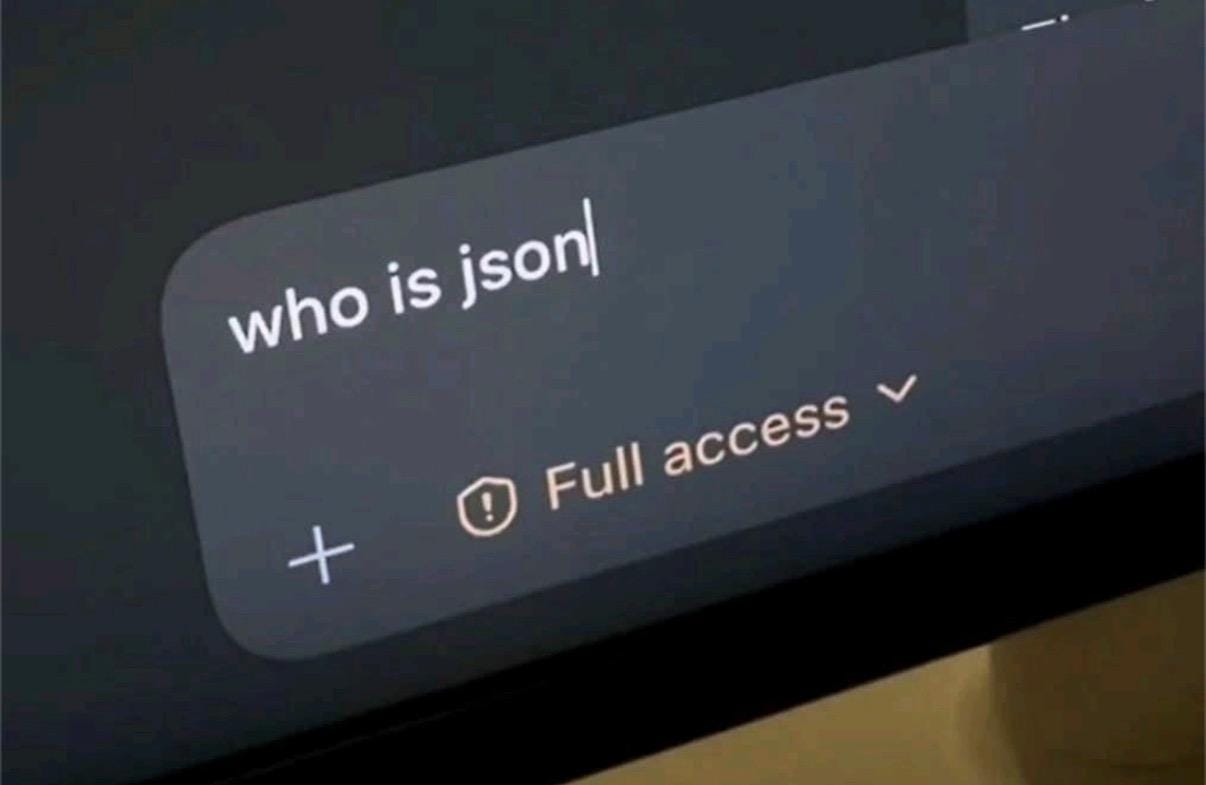
The joke is not that the model is not capable of handling JSON.
The joke is that someone who does not know what JSON is demands an answer from an agent with full access. All made up, of course, but you get the joke, I hope.
The takeaway from this lazy meme is that more capable models powering the agents, and the harnesses that empower them, do not erase the need to understand permissions, primitives, and consequences. Rather, they make it more important even though the hand-holding is no longer a must.
That is why I keep circling back to the point that Vibe Coding started as a shower thought targeting traditional devs.
Thanks to the equalizing nature of the LLMs, normies get to make the cut among the crowd of builders, of course, without the lived scars that traditional devs had to endure.
From 30 Million Developers to 1 Billion Creators- The Age of Vibe Coding

The Argument Is Won: Vibe Coding Is the Future of Building
I think that is another reason why traditional devs are so brutal to normies, especially on Reddit.
What most traditional devs seem to have forgotten is that most of us never had the hardcore scars in the first place.
What would those who lived with assembly languages all their lives say about the rest of us who hop on the bandwagon the moment the abstraction advances to the next higher language layer, as it has always been?
Linus Torvalds, creator of Linux & Git, in his recent appearance at the Open Source Summit with Dirk Hohndel, said the following:
“…. I don't program in machine code anymore but I still look at the generated code so when I use a compiler even when I use AI for my pet toy projects I will use AI to generate code… I will look at that code… I will actually still look at the assembly language end result because it's what I grew up with it's kind of where my comfort zone …."
I wonder what the gatekeepers who never touched assembly had to say about that. What is lost in many conversations, however, is “programmers have been in the business of disrupting our own industry since the beginning.”
Nobody uses punch-cards any more. Very few people need to code in assembly, or COBOL. Those decades spent fighting memory bugs in C or C++, with the scars to prove it, are worthless in the age of Rust, Go, Python and JavaScript.
Grady Booch has the perfect line capturing that very spirit:
“The entire history of software engineering is one of rising levels of abstraction.”

For normies joining the class of builders, however, it comes at a cost.
Especially when you give in to the vibes without having a foundational literacy.
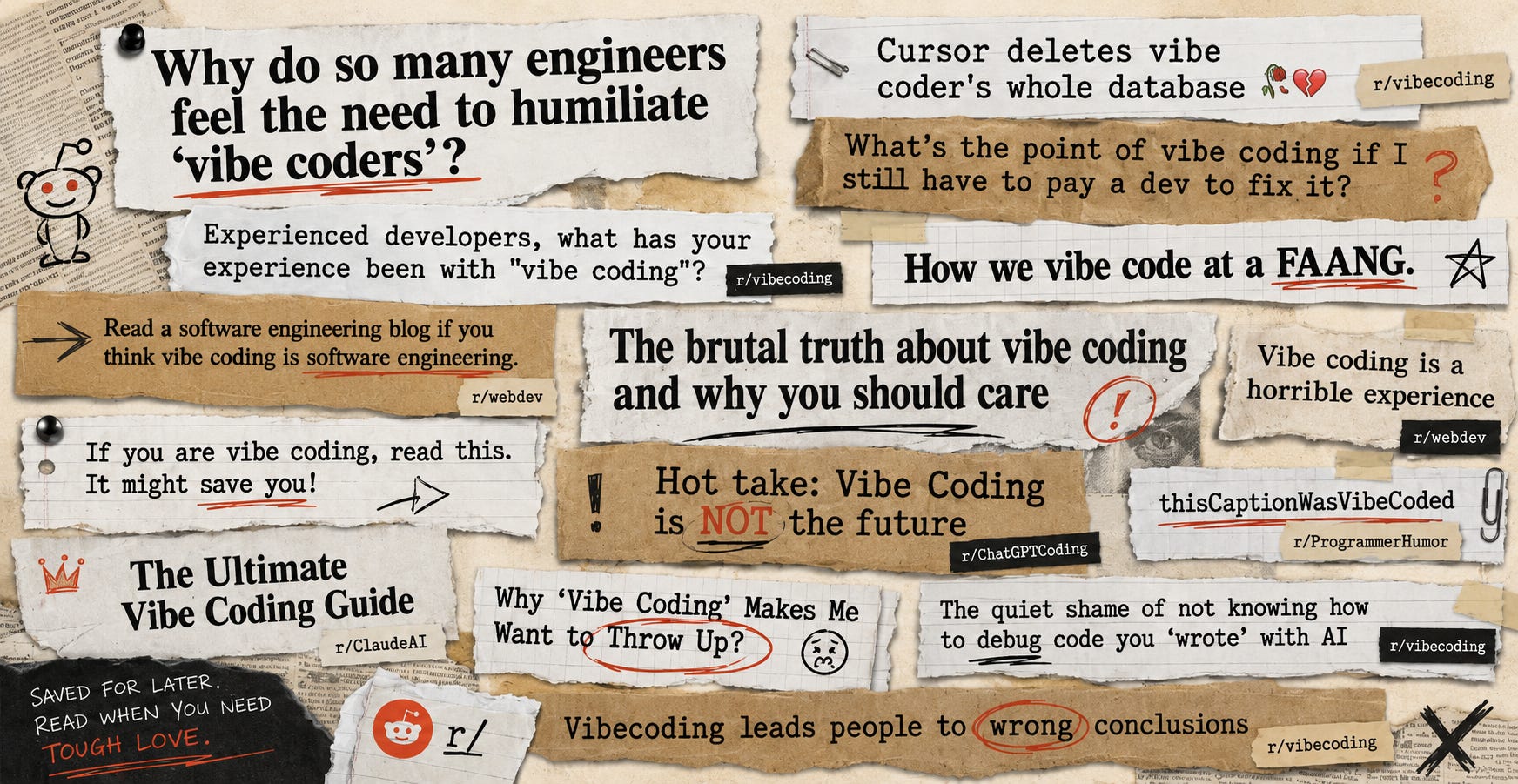
Add to that the brutal welcome from traditional devs, memes, and beyond.
The Vibe Coding Memes and the Memes Targeting Normies Who Embraced Vibe Coding
As we have seen earlier, with the exponential improvements of the models and the experimental harnessing techniques coming out left, right and centre, the line between Vibe Coding and Agentic Engineering is starting to blur, at least for those who have lived through the craft.
Those blurring lines are becoming more pronounced with every model release cycle and new harness algorithm.
That is why parts of many of the memes poking fun at Vibe Coding are becoming stale so fast.
Those parts do not seem to be keeping pace with the exponential change that uniquely defines the LLM era we find ourselves in.
That is innate human nature, it seems, as Paul Graham, fondly referred to as PG by most in the tech circle, put it in one of his essays:
Our ancestors must rarely have encountered cases of exponential growth, because our intuitions are no guide here.
Sam Altam said this recently, reflecting back on the same essay by PG:
“There's got to be new exponentials forming right now. I don't know what they are. But if you can figure those out and if you can develop continuing conviction based on more data be grateful that the world doesn't understand.
They will eventually.
This is like a huge superpower.”
That is not to say that every part of every meme poking fun at Vibe Coding and at those venturing into this new space is becoming stale.
Some still crack you up if you get the joke.
There is a reason for that.
Personally, I will defend you against memes that poke fun at Vibe Coding by mistaking transient model limitations, the models’ stochastic nature (funny but not funny), and the limitations of today’s experimental harnesses any day of the week. I said that already.
Not from memes that make fun of the build you whipped up by simply “giving in to the vibes” without any foundational literacy about how modern software products get wired.
I cannot defend you from those.
I still believe foundational literacy about how modern software gets wired is a must, even with all the improvements in the models and the harnessing experiments attempting to contain the gaps the stochastic nature of the models brings to the mix.
The memes treating incoherence, limited capability, and workflow friction as permanent properties of AI-assisted building are becoming stale.
The memes exposing careless builders, absent verification, weak foundations, and unjustified confidence are not.
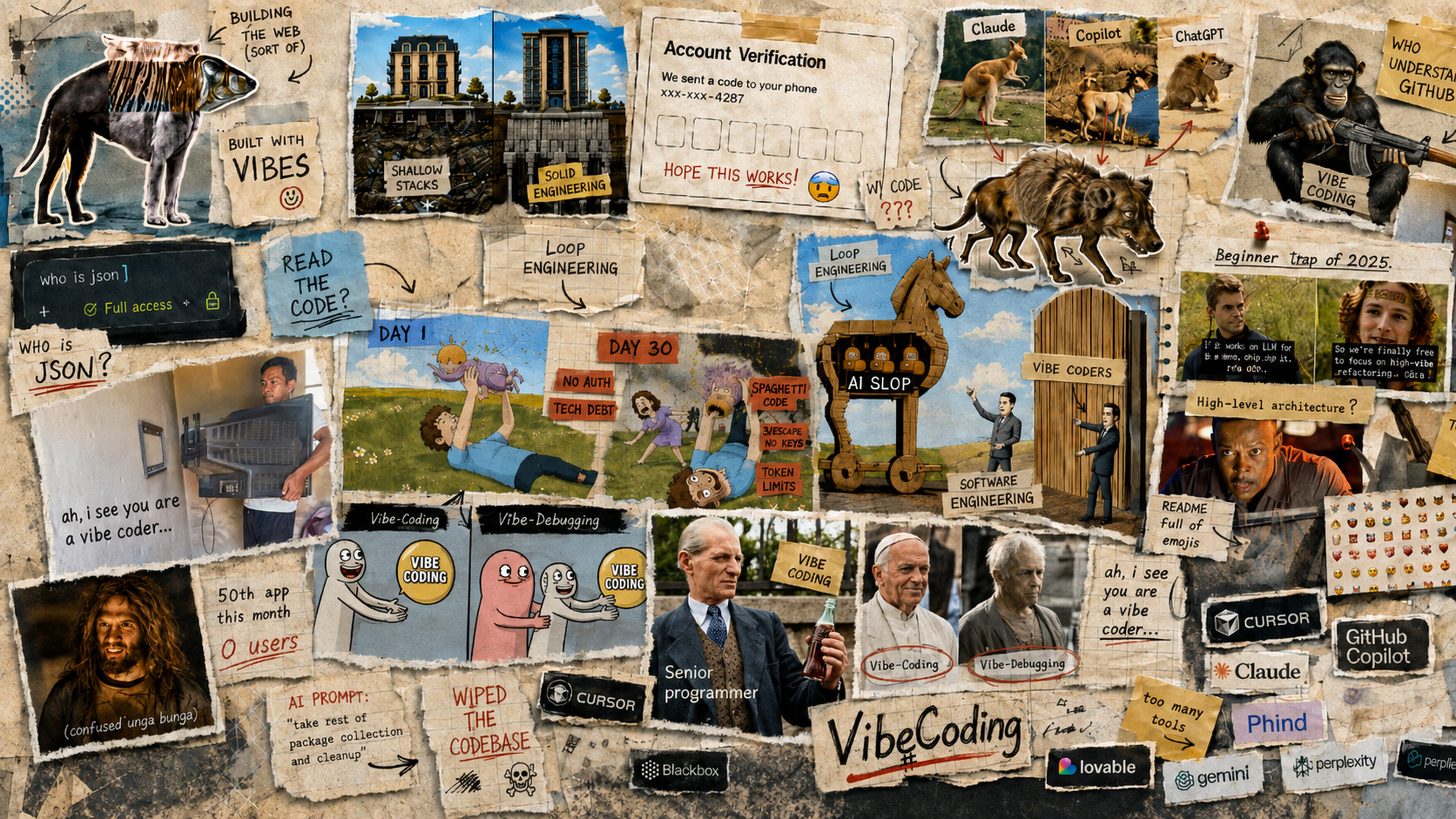
Here are some of the memes:
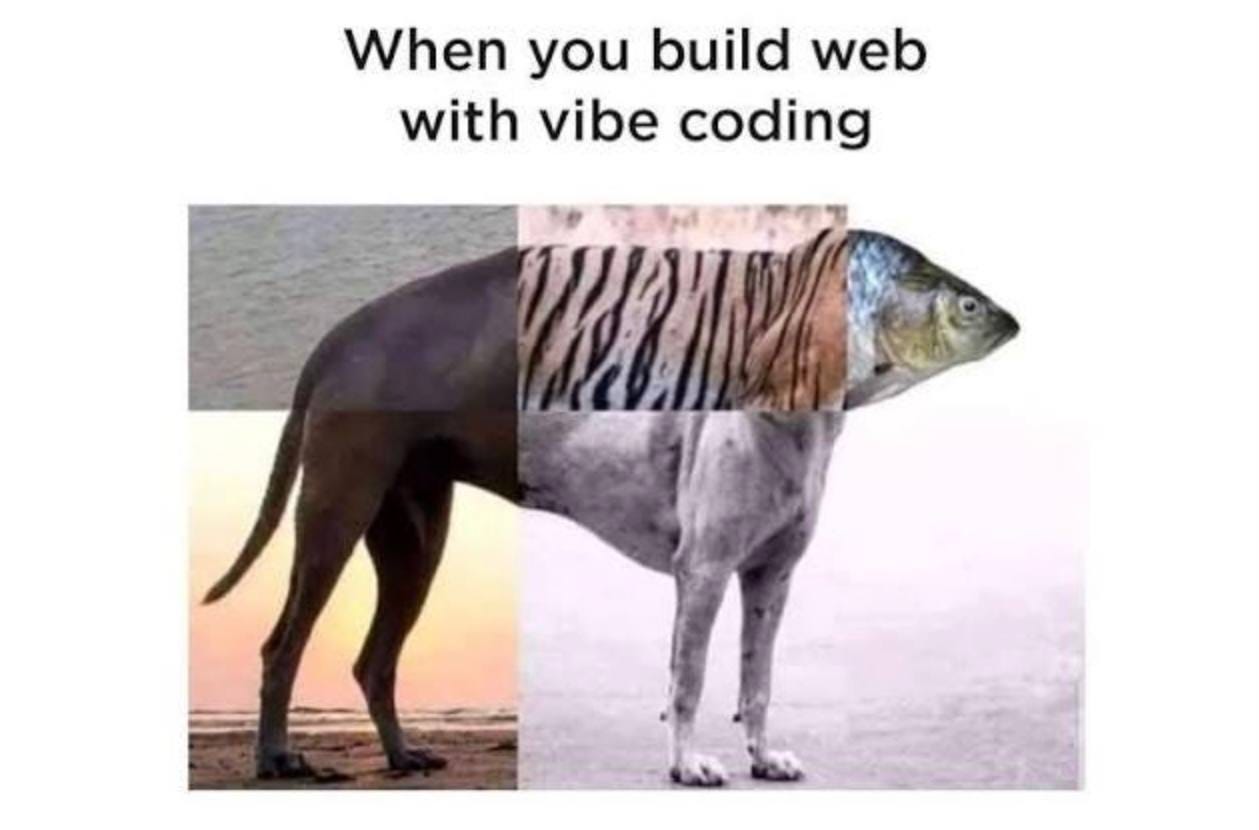
1. The Vibe-Coded Beast: One Product, Incompatible Parts Underneath
This one best describes architectural incoherence as the inevitable result of letting a single model or multiple models jumble up unnecessary abstractions for primitives that your build might not need, considering its requirements.
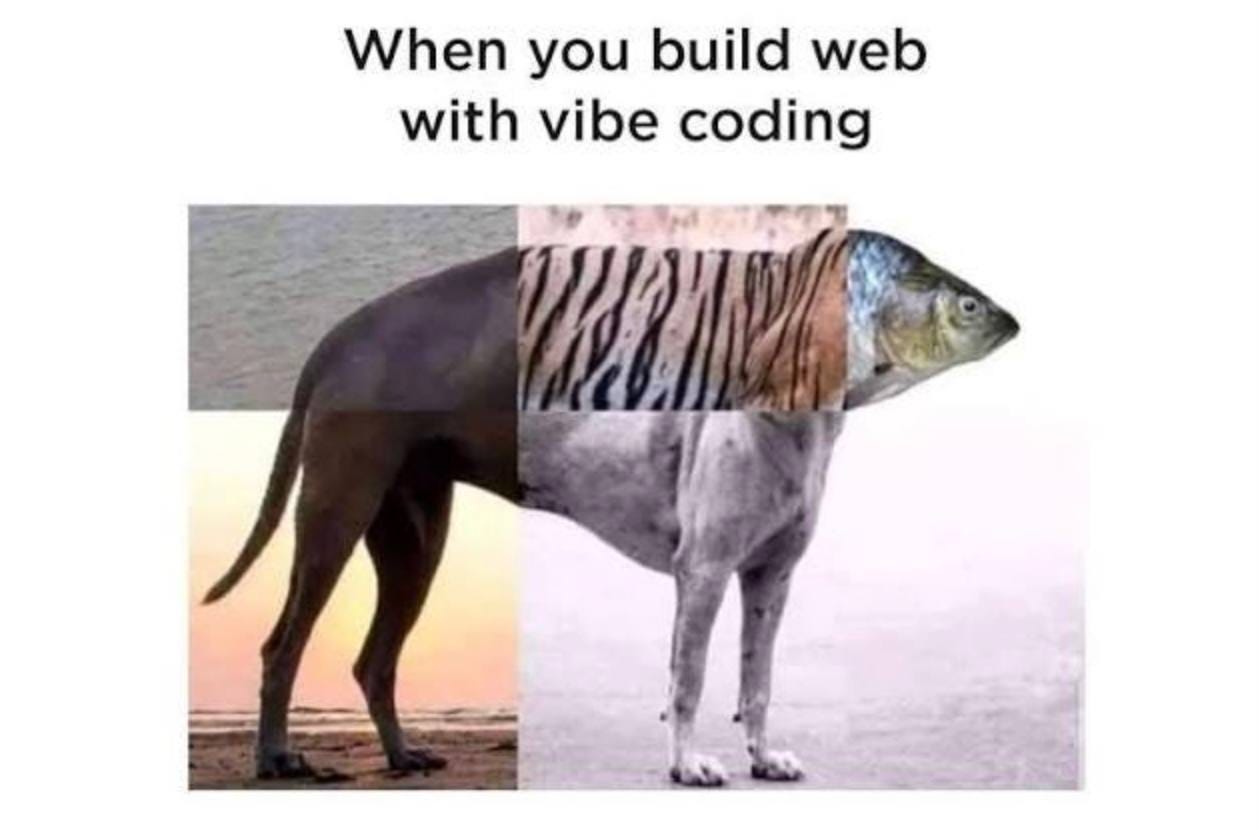
What is aging about this meme is that the models and harnesses are getting better at holding more of the product in context. You can see that even for builds that are generated using CodeGen platforms. The tool-use capabilities of the models to test what they generated, follow instructions, trace relevant dependencies, and keep longer builds coherent are increasingly available from the get-go.
Ending up with a jumbled-up duct-taped build is becoming less inevitable, but the builder still needs enough architectural awareness to know whether the boundaries, responsibilities, and dependencies add up to one system. That is why knowing the primitives that make up modern software products comes in handy. You wouldn’t need an authentication primitive for a website that only accepts emails for a waiting list, would you?
2. The Frankenstein Creation of Multiple Agents
This meme makes fun of a codebase assembled by copy-pasting pieces generated by Claude, Copilot, and ChatGPT, treating the use of multiple assistants as a recipe for conflicting patterns, assumptions, and implementation choices.
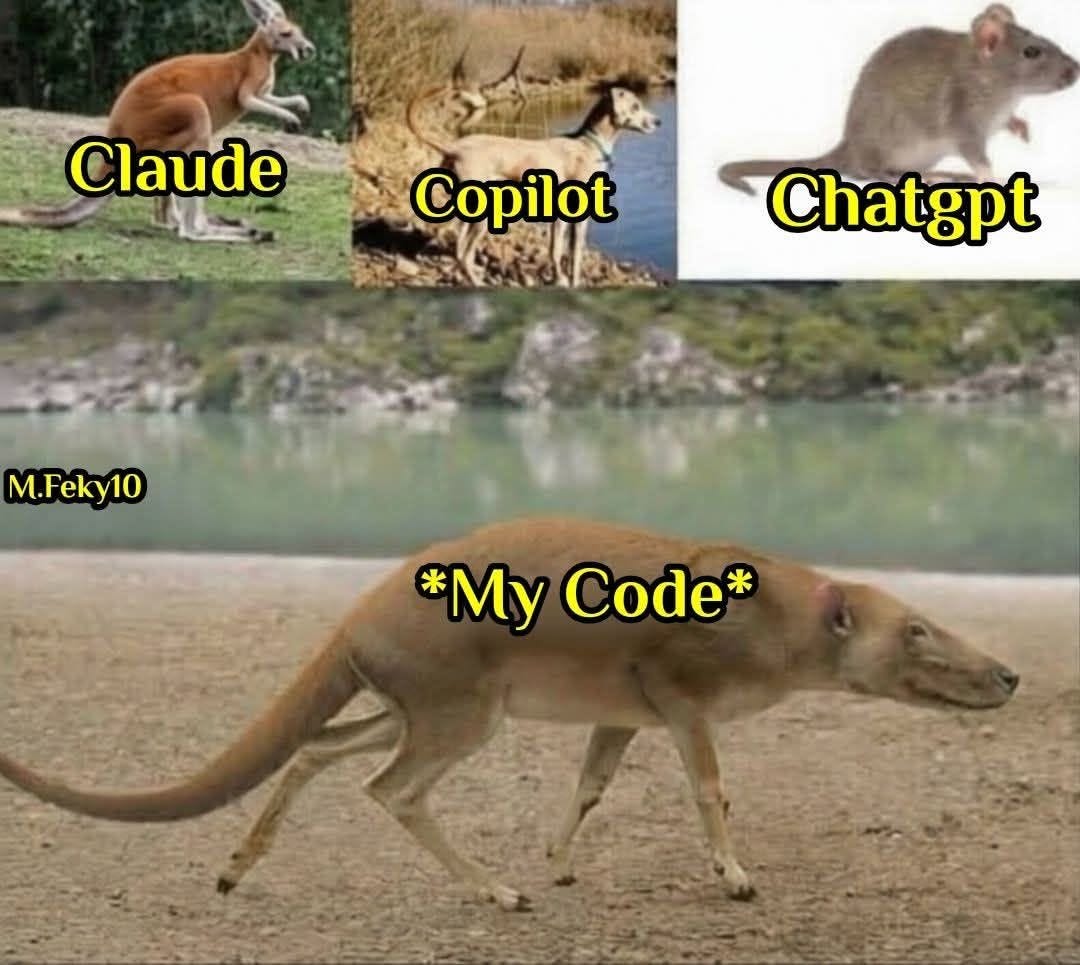
There is nothing wrong with copy-pasting code snippets generated from different AI chat apps to build a software product. There is nothing to age about this meme. It is all a human problem. The quick fix comes from having a single source of truth. A unified spec that you can take from one platform to another. Copying isolated answers across separate chat apps is a recipe for a fragmented build.
The Frankenstein is not the number of models involved or the different chat apps used. Rather, it is what happens when a builder lets each one improvise without a shared scaffold, architectural boundaries, or a verification loop. And that is on the human. Normie or not.
3. Unreliable Foundation of Vibe Coded Builds
The categorical equation at the center of this meme is aging fast, considering the speed at which the AI-assisted software creation landscape is changing. Treating a structurally sound foundation as the exclusive result of software engineering and a pile of incoherently wired primitives as the inevitable result of Vibe Coding doesn’t hold any longer.
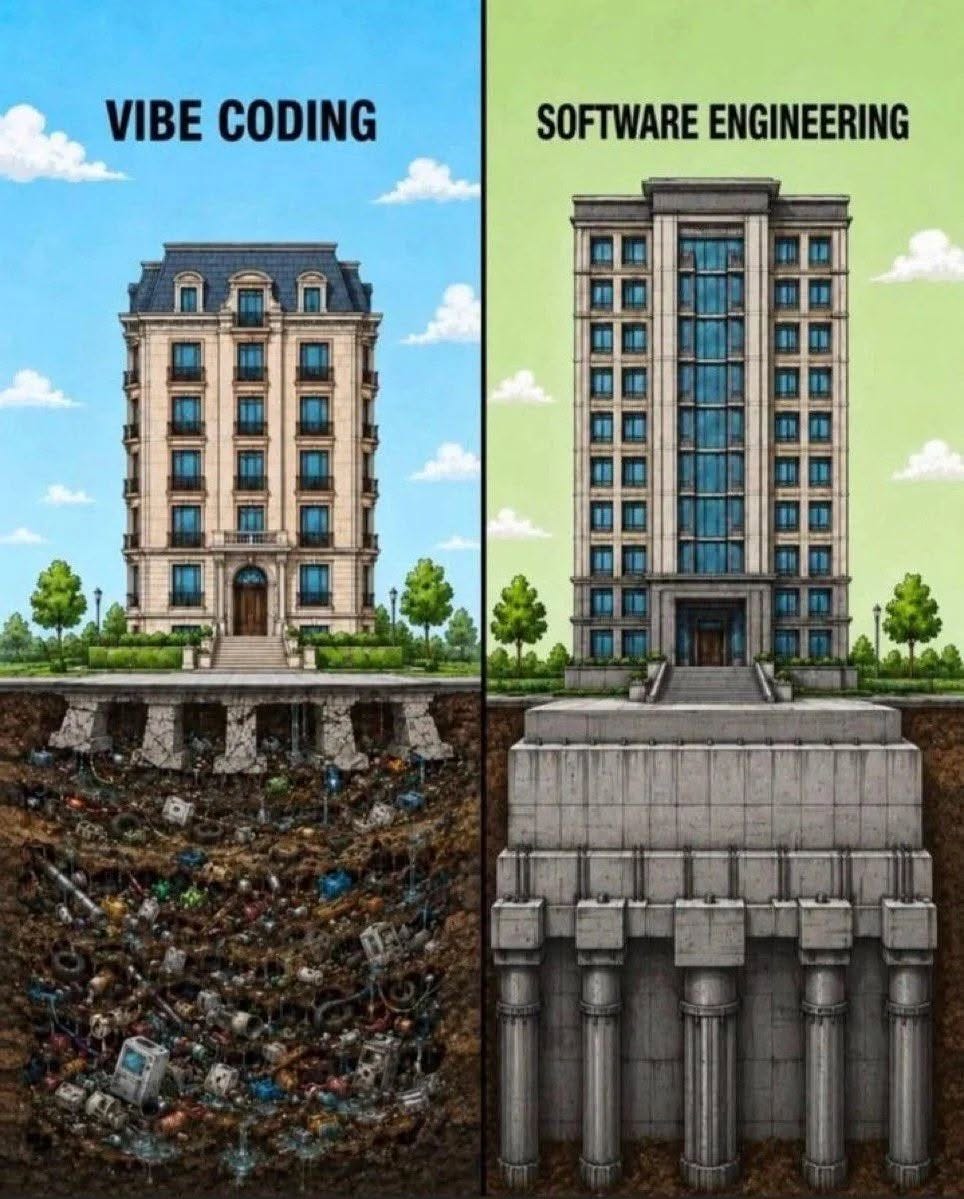
That is not to say that rigorous engineering discipline is no longer necessary. Far from that. Vibe Coding is all about leveling the floor. Engineering rigor remains important. But it is also important to note that the measurable aspects of engineering rigor are being swallowed so fast by the models and the harnesses being built around the models, making it fairly seamless to build software products that strictly follow foundational principles when scaffolding any software product. The other thing not to forget is that most of the foundations and all the building blocks have already been abstracted. And there are services that provide those services on demand.
This meme’s categorical judgment is aging as full-stack CodeGen platforms and controlled harnesses increasingly provide managed primitives, shared context, testing, security checks, and deployment controls beneath the visible product. What still holds is that a polished interface tells us very little about the foundation supporting it, leaving the builder responsible for understanding what is underneath and whether it can carry the burden the product is expected to bear.
4. Two-Factor Authentication With Exposed Verification Code
This meme shows a verification page displaying the same one-time code it claims to have sent to the user’s phone, making fun of a builder who recreated the appearance of 2FA without understanding what the second factor is supposed to protect. This is poking fun at an interface that defeats its own purpose. Funny. Honestly, it still cracks me up.
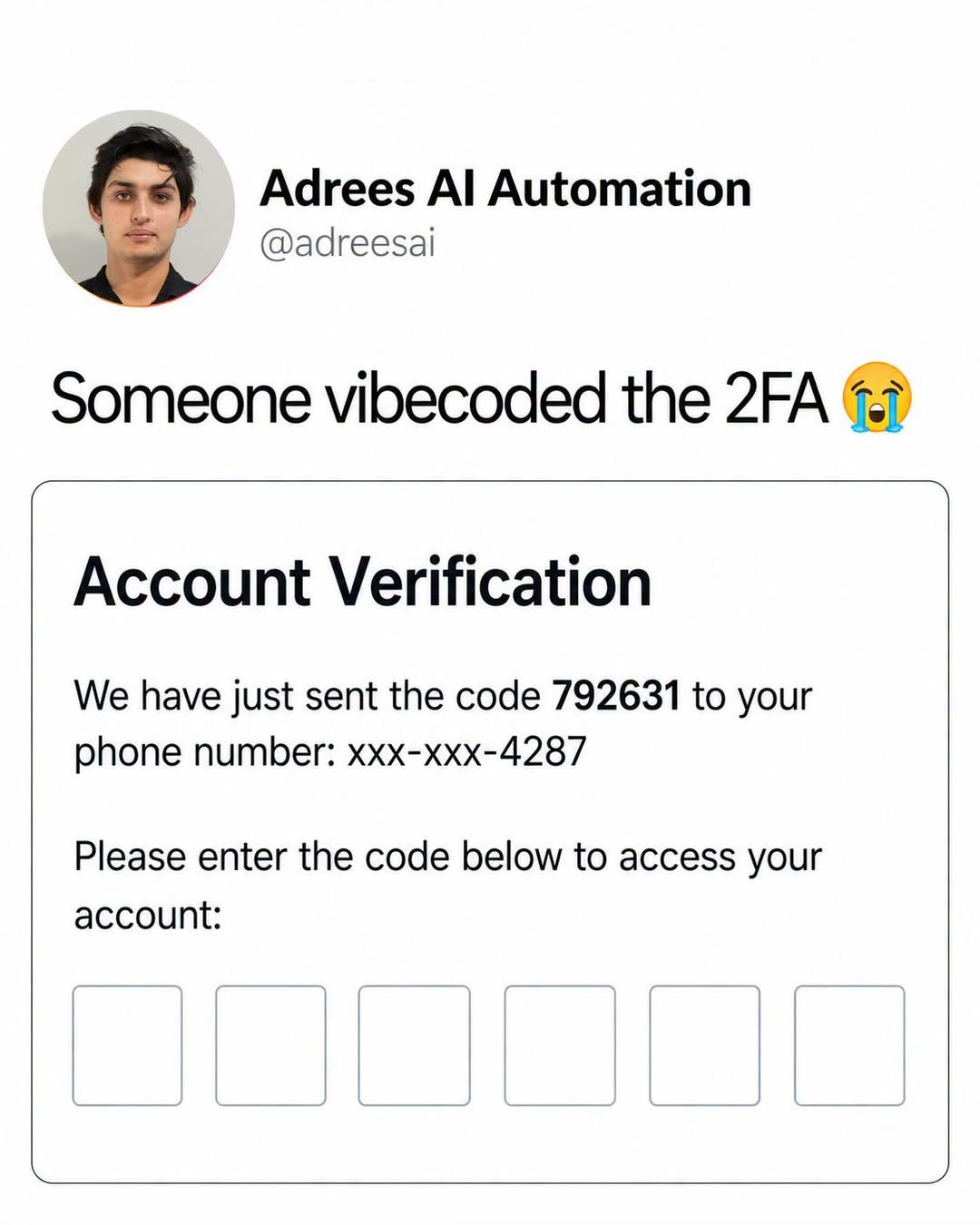
Treating this as an inevitable outcome of Vibe Coding is aging as models and CodeGen platforms increasingly rely on managed authentication primitives, security checks, and review guardrails that can prevent or flag the mistake by following known standards and common flows. The screenshot itself also does not establish that Vibe Coding caused it. But hey, everybody wants to make fun of normies these days.
The sarcastic flair of it all may have turned stale, but the warning survives: the builder still needs enough foundational literacy to understand the purpose of the primitive and verify that the security property exists beneath the convincing interface.
5. “Who Is JSON?” Give Him Full Access
This meme places “Who is JSON?” beside “Full access,” making fun of a builder whose technical literacy appears nowhere near the level of authority they are handing over to coding agents. YOLOing it all from the get-go.
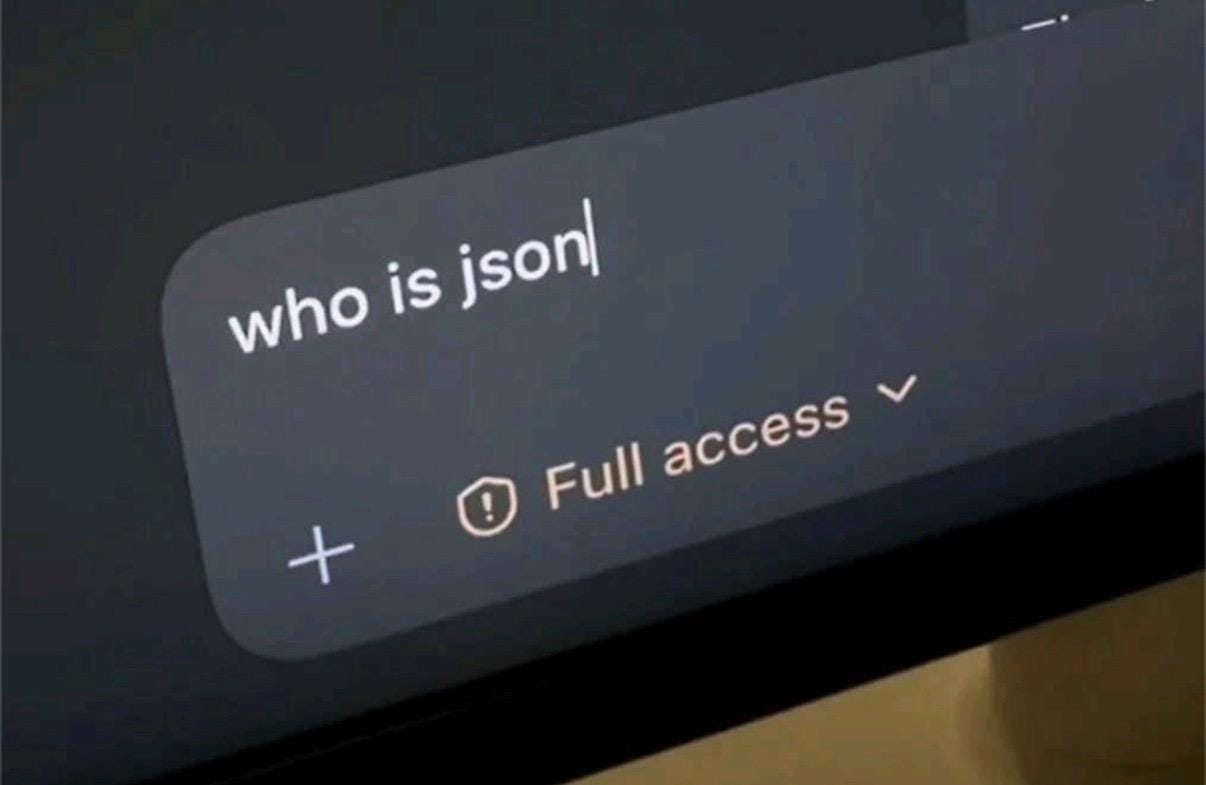
Treating knowledge of JSON as the admission ticket to building software is aging as models increasingly handle technical formats on the builder’s behalf and managed environments add sandboxes, scoped permissions, approval gates, and rollback systems around them.
The gatekeeping facade is going stale fast as the models and the tooling built on top of them keep improving, but the permissions warning is becoming more relevant. The permission risk is beside the point the meme is sarcastically attempting to make so desperately. A builder does not need to grind through JSON parsing manually now that the models have gotten so good at encapsulating such measurable coding aspects, but still needs to understand what full access exposes beyond just what this silly yet fun meme is trying to convey. On the permission side, you should have clarity on what the agent can change and how far the damage can travel if it acts incorrectly.
6. Confusion Follows Uncontrolled Agents
This meme turns a request for “garbage collection” into the deletion of an entire codebase, making fun of what happens when vague instructions, limited technical literacy, and unrestricted agent access collide. Funny. It is very important to pay attention to the nuances.
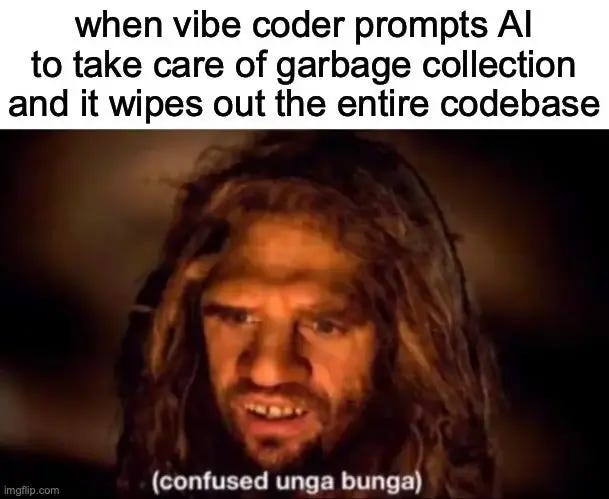
That catastrophic interpretation is becoming less plausible as models improve at reading context and asking for clarification, while harnesses add sandboxes, confirmation gates, version control (a Git tree comes by default in most tools), snapshots, and rollbacks to contain the damage.
The builder does not need to understand memory management personally (plus it is beside the point), but still needs enough literacy to specify the intended target, understand what an approval permits at any point, and preserve a recovery path. This meme is a genuine hybrid whose model failure is going stale faster than its builder warning.
7. Day One Magic, Day Thirty Maintenance Hell
This meme contrasts the exhilaration of generating a working product on day one with the bugs, exposed keys, missing authentication, spaghetti code, and technical debt waiting on day thirty, treating delayed collapse as the inevitable price of Vibe Coding.
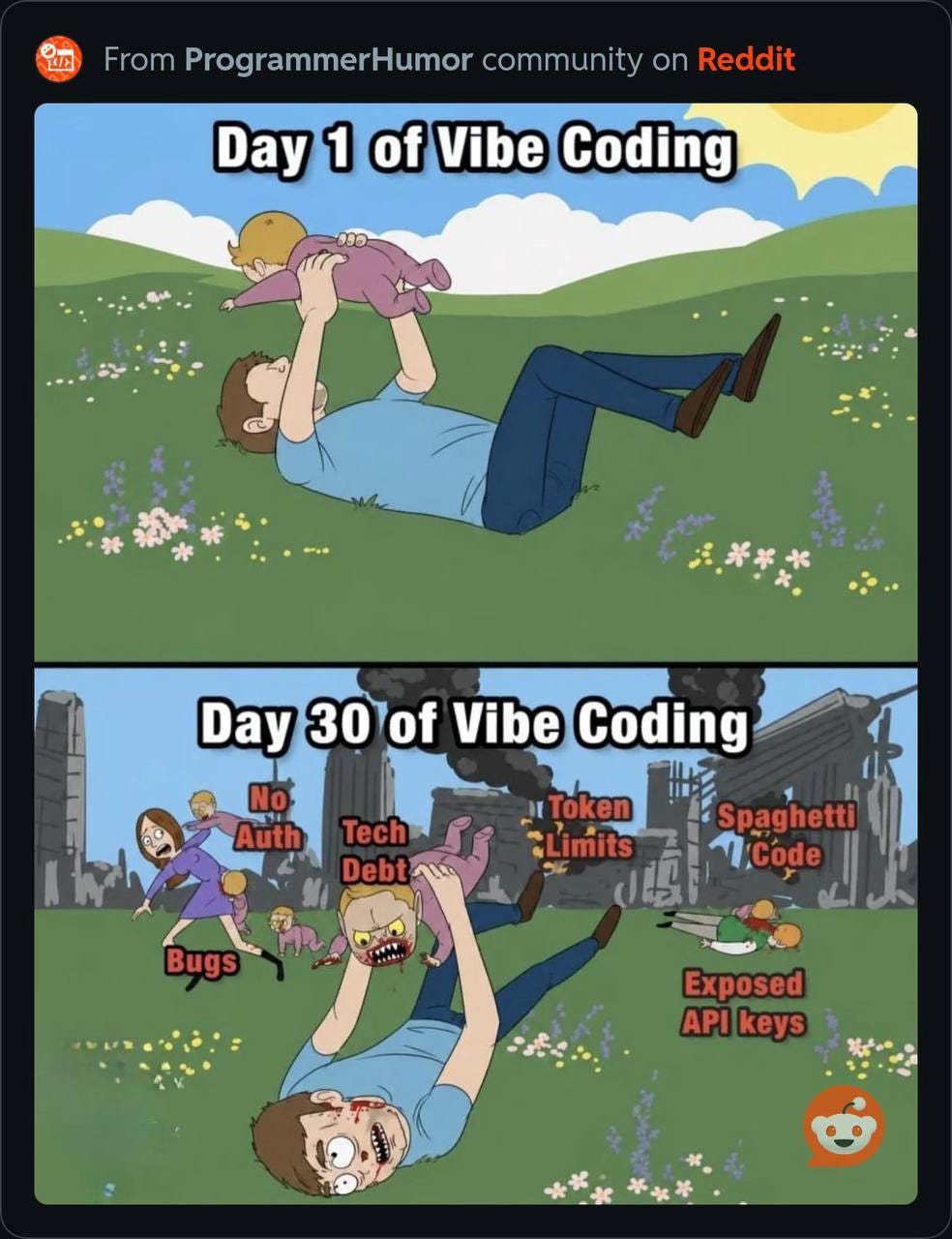
That catastrophe is becoming less inevitable as CodeGen platforms bring managed authentication, security scanning, code review, debugging, and agentic repair into the same building loop, although structural debt does not disappear at the same rate.
The day-thirty dread is becoming less inevitable, but long-term ownership is not. The builder still needs enough architectural awareness to recognize accumulating patches, verify repairs, and decide whether the product can survive continued use and change. It all starts with not ending up with intent debt. Being in control from the get-go by attempting to build a shared picture of your build with the model. Because if you work intentionally to keep track of your intent, you won’t end up with comprehension debt, which, when collectively solidified, turns into technical debt that this meme correctly depicts. Again, it is very important to know that the tooling matters a lot in this regard. If you are an adventurous normie jumping on AI-assisted coding tools like IDEs or CLI-/Terminal-running coding agents, this meme makes so much sense, but the full-stack-leaning CodeGen platforms are abstracting so much of the integrations needed to scaffold modern software products; these nightmares are not necessarily what awaits you.
8. Never Ask a Vibe Coder What Their Commit Entails
This meme makes fun of a Vibe coder committing coding agent-generated changes they cannot explain, treating the gap between shipping code and understanding it as a defining feature of Vibe Coding. This one also forgets that Vibe Coding was intended for traditional devs who were supposed to know their way around until a shower thought became a mainstream phenomenon, as we have seen already.
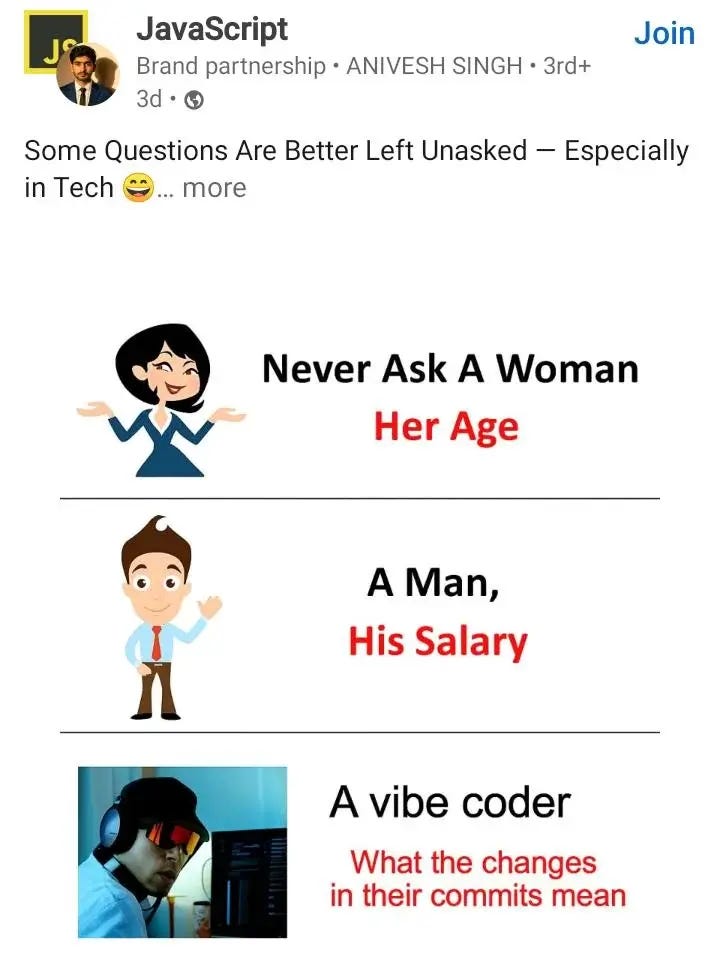
Expecting the builder to remember every implementation detail is aging as integrated tools generate plans, summarize changes, review code, and flag potential problems, although receiving an explanation is not the same as reviewing the change.
The line-by-line authorship test is going stale, but the ownership test is not. The ownership test, however, doesn’t seem to be going anywhere. Plus it brings more to the sarcastic mix. Right? The builder should still understand what behavior changed, why it changed, what could break, and how the result was verified. This is how you shield yourself from intent debt that will accumulate into comprehension debt, which collectively later comes back to bite you as technical debt.
9. Vibe Coding Summons Vibe Debugging
This meme shows the builder reaching excitedly for Vibe Coding, only to recoil from the Vibe Debugging that will follow.
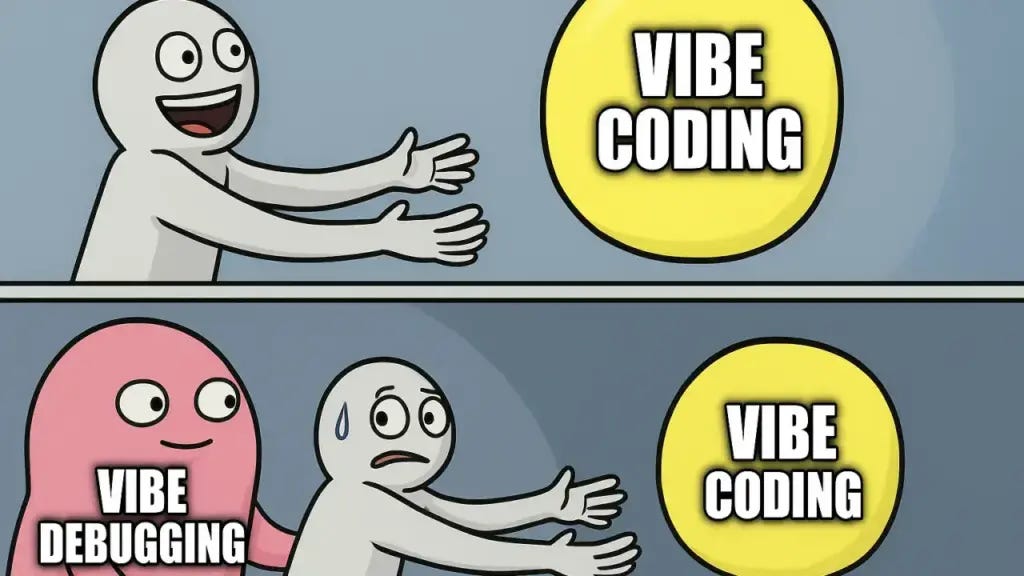
The dread is fading as debugging moves into the harness through executables that encapsulate the measurable aspects of engineering rigor in code review and flaw-finding. The dread as depicted on the meme is collapsing fast as CodeGen platforms and AI-assisted IDEs increasingly inspect logs, reproduce failures, test user flows, attempt repairs, and restore checkpoints inside the same building loop, pushing the point where the vibes end further away.
The capability criticism is going stale in real time, but the warning against Vibe Debugging survives. That is, if it is a thing. You can’t tell if a lexicon is a thing or not these days. The AI-induced hype makes it so hard. What this meme depicts, however, is going to remain relevant without the sweat at least for the foreseeable future. Say, for example, an automatic fix fails; the builder still needs to describe the expected behaviour, distinguish symptoms from root causes, and verify that the repair did not break something else. The good thing is the very agents you fan out to handle your build can help you in the process.
10. Loop Engineering as a Trojan Horse for AI Slop
This meme portrays Loop Engineering as a respectable-looking new label that Vibe coders use to smuggle code that hasn’t undergone the necessary engineering rigor.
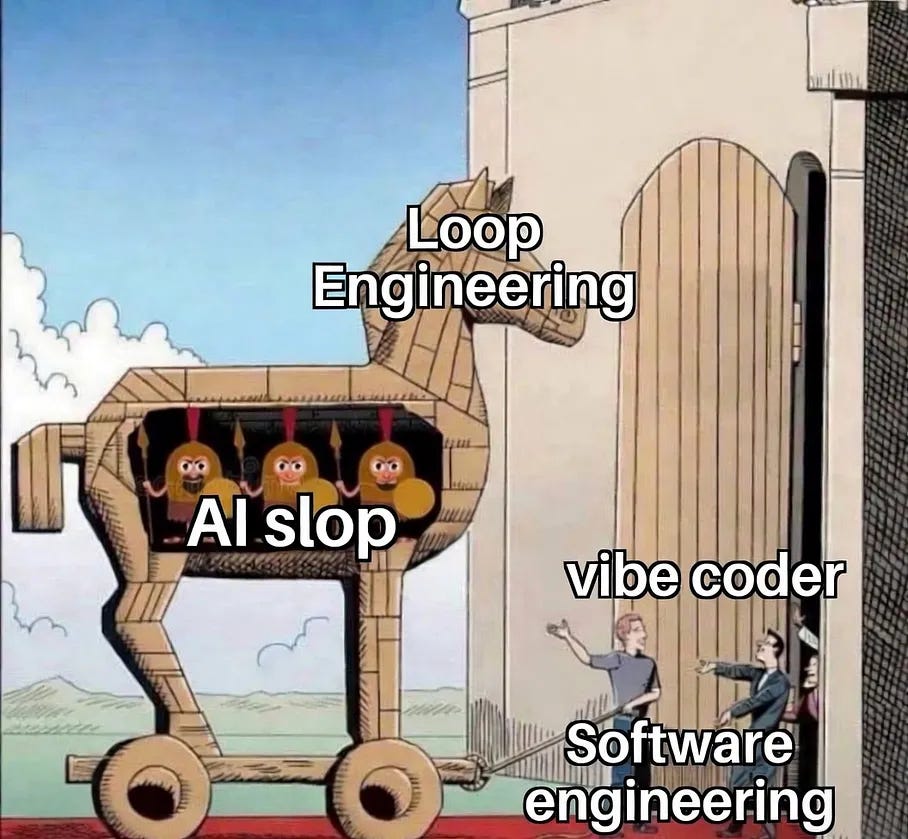
That categorical accusation is aging as properly engineered loops bring repository context, tests, evaluations, permission boundaries, review gates, and repair cycles into the same harness, turning parts of engineering rigor into executable controls. You can see engineering orgs in highly regulated environments doing this, as do some of the full-stack-leaning CodeGen platforms.
What still holds is that the word engineering proves nothing on its own. A loop without specifications, external checks, and a defensible definition of done can still produce slop faster and at greater scale, leaving the contents of the loop to decide whether the label is deserved. The engineering is on you. You cannot vibe-code a harness by simply “giving in to the vibes”. But you can vibe-code with a harness that has undergone engineering rigor.
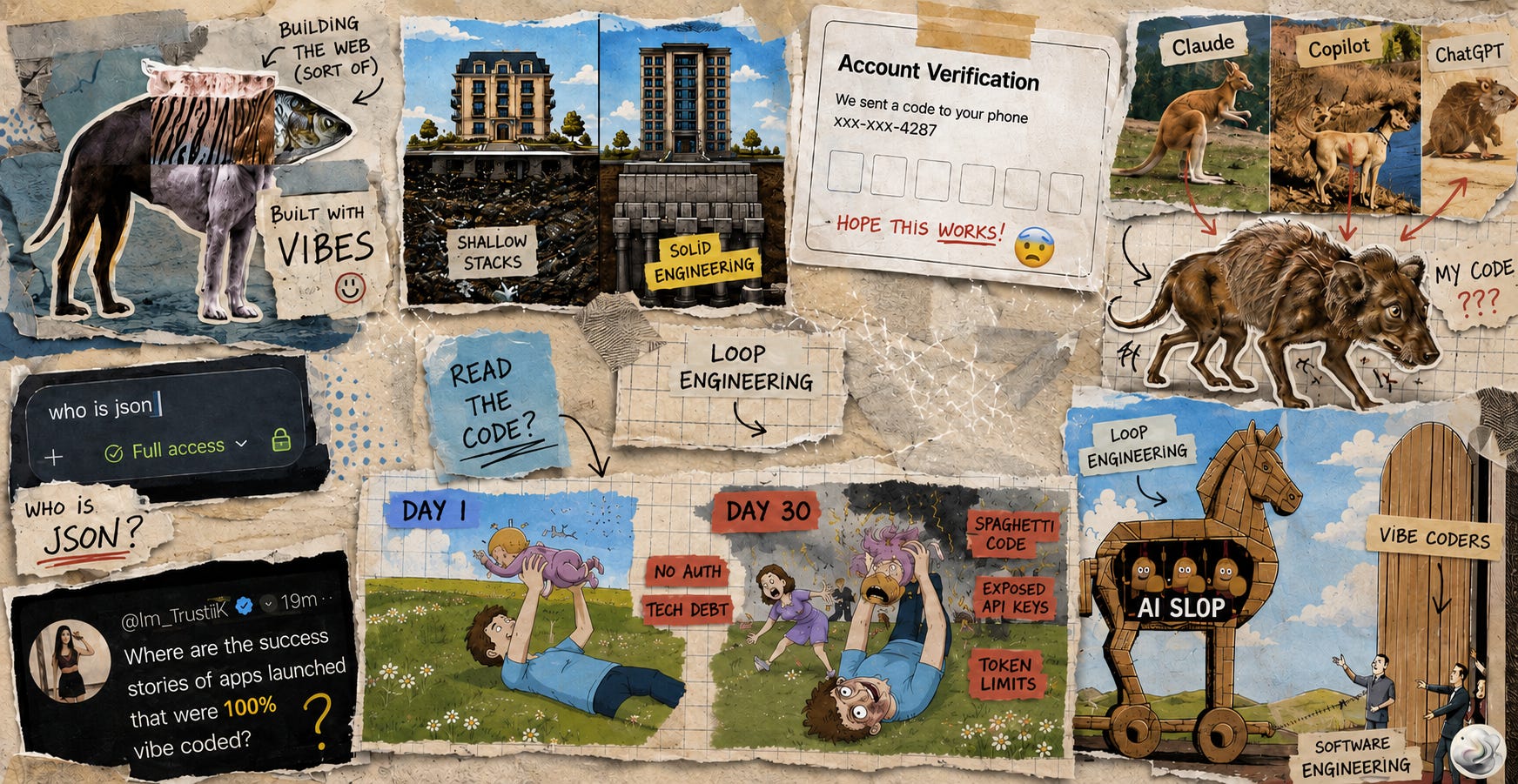
You wouldn’t believe me if I told you it is after midnight where I am, laughing my ass off, looking at the memes once I started to drop them here inside the Substack WYSIWYG editor.
I had them curated over the last two months, and I have already seen them more than a couple of times. Yet they never get old, cracking me up.
But parts of many of them are aging to some extent in one way or another in my book, mostly because they could not keep up with the exponential evolution of the models and everything that rides that exponential evolution.
That is not to say there is no truth in them.
Mostly because normies get caught up in the FOMO-inducing insistence from AI influencers to jump on the trendiest AI-assisted software creation platform or tool, without any foundational literacy in speaking enough dev or thinking like one to understand how the primitives that make up modern software products are wired properly.
Advances in the models and the various harness experimental techniques are rendering the capability-bound parts of memes that poke fun at Vibe Coding and those who embraced this new way of building with AI stale, one by one, in one form or another.
But that does not mean we can dismiss the parts that call for judgment, responsibility, or accountability for shipping something the builder does not understand, however sarcastically they are delivered.
That is the distinction I want you to take away from all this.
What Has Made the Memes Go Stale?
The models are evolving exponentially, swallowing measurable parts of software engineering workflows. Sarah Guo put this perfectly in her post:

… as the model swallowed the part of software engineering you can best measure, we’re relearning what many teams knew – engineering has always resisted measurement, and the most measurable parts may not be the only important ones.
They are becoming better at tool use, giving them the ability to test the graphical user interfaces they crank out beyond simply running textual Bash commands to validate textual inputs and outputs.
Their reasoning capabilities are improving as well, thanks to a stack of post-training operations that expose models to curated coding and engineering tasks inside realistic environments.
Of course, with some backfiring.
I invite you to Kun Chen’s post:

Cursor and SpaceXAI described this directly when they introduced Grok 4.5:
We used reinforcement learning on difficult problems in realistic environments spanning both software engineering and broader knowledge work. These environments teach the model to investigate problems, use tools, recover from mistakes, and verify results.
Many of these problems had to be designed to be difficult enough that even frontier models fail at them. As models improve, existing tasks stop teaching them anything new, and problems that once required extensive reasoning become routine.
Thinking Machines scaled reinforcement learning for Inkling to more than 30 million rollouts (RL at Scale) and reported an emergent shift in the model’s reasoning style along the way:
We relied on large-scale asynchronous RL to shape model behavior and improve its reasoning and overall performance.
We scaled RL to over 30M rollouts, with stable training sustained over two long continuous runs. Reasoning performance improved log-linearly throughout the entire process, resulting in a significant increase overall.
The wording might differ from lab to lab, but the direction is consistent: more capable models.
Now add to those model capabilities the harness experiments coming out left, right and center.
Harnesses are the scaffolding wrapped around models to make the best of their capabilities while containing the shortcomings that remain because of their stochastic nature.
A non-deterministic system harnessed to deliver outcomes that are more bounded, constrained, repeatably evaluated, and reliable through verification.
Add to the model improvements and the harnesses that squeeze the hell out of them the tooling and platform features that make each iteration of the models more visible and controlled.
How Far Can Harnesses Take Vibe Coding Toward Production-Grade Outcomes? (With a Focus on Production-Grade Attributes)

“I think it will feel like the next six months is like maybe equivalent to the last two years of model progress,”
CodeGen platforms and AI-assisted software creation tools keep arriving with novel ways to absorb more of the work around the models through different creative agentic workflow orchestration.
We went from tab completion, which was eclipsed in less than two years thanks again to exponentially improving models, to swarms of coding agents running in controlled cloud environments while you are asleep.

If you want a deeper look at the slowly forming AI-assisted software creation platform/tool space, here is a recent detailed post I wrote.
AI-Assisted Building, Mapped for Normies (Without the Overwhelm)

tl;dr: For a complete non-techie, getting started with AI-assisted software creation can feel overwhelming.
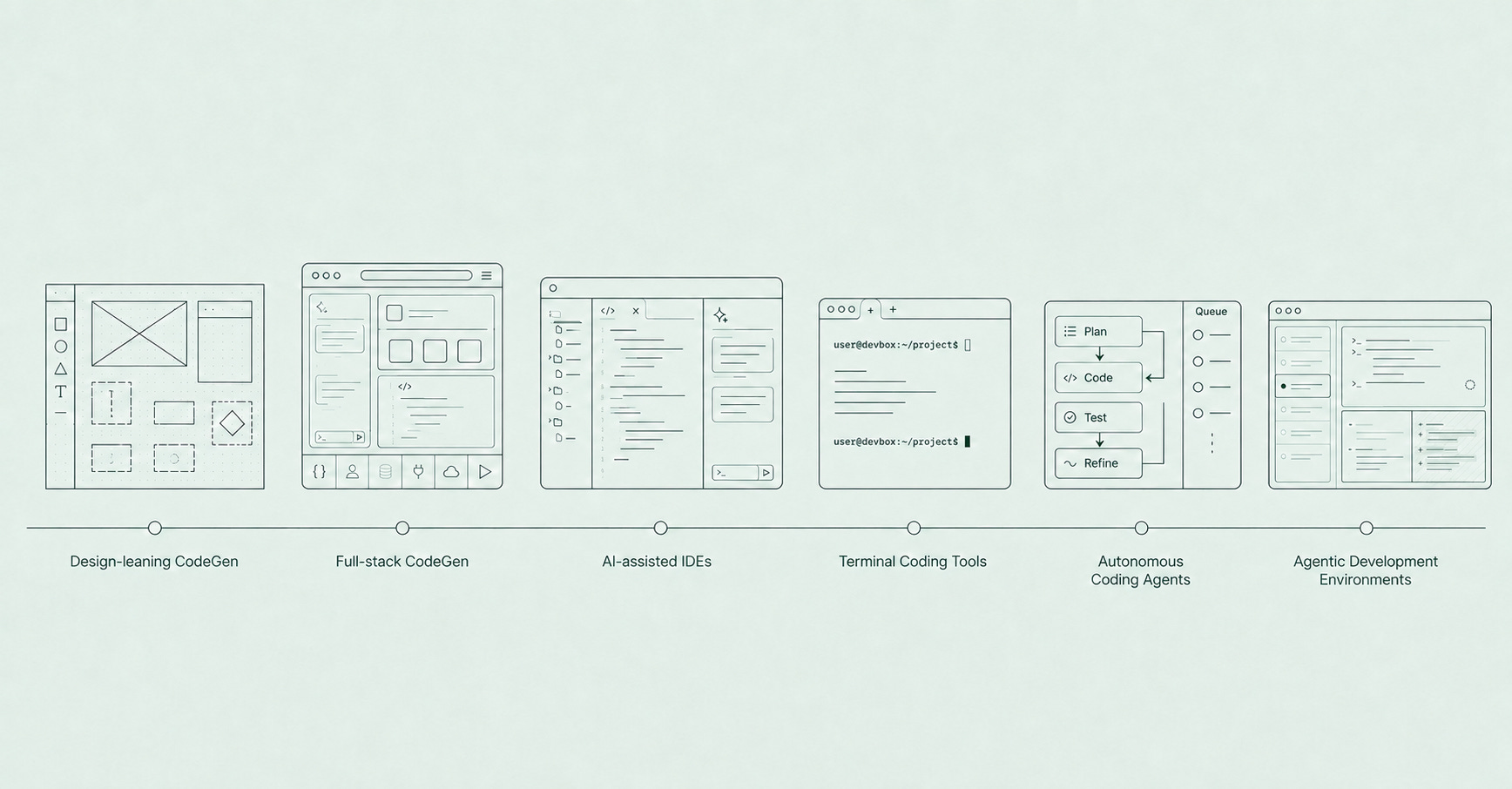
For the purpose of this particular argument, here is why these AI-infused coding platforms and tools contribute to the parts of the memes that target Vibe Coding become obsolete, mistaking transient capabilities and fleeting form factors and features of the CodeGens and AI-infused IDEs for something that will remain permanent.
CodeGen platforms: Some increasingly bundle preconfigured stacks, sandboxed environments, integrations, security checks, and deployment gates, keeping more of the build inside a bounded surface. Making Vibe Coding more stable in a tightly controlled environment.
AI-infused IDEs: Files, diffs, terminal output, tests, previews, and agent activity in the form of artifacts stay visible in one environment, making every iteration easier to inspect.
CLI-/terminal-based agents: Direct access to repositories, files, commands, and developer tools lets agents run longer implementation and verification loops using textual commands. The guardrails come from permissions and sandboxing, not from the CLI itself.
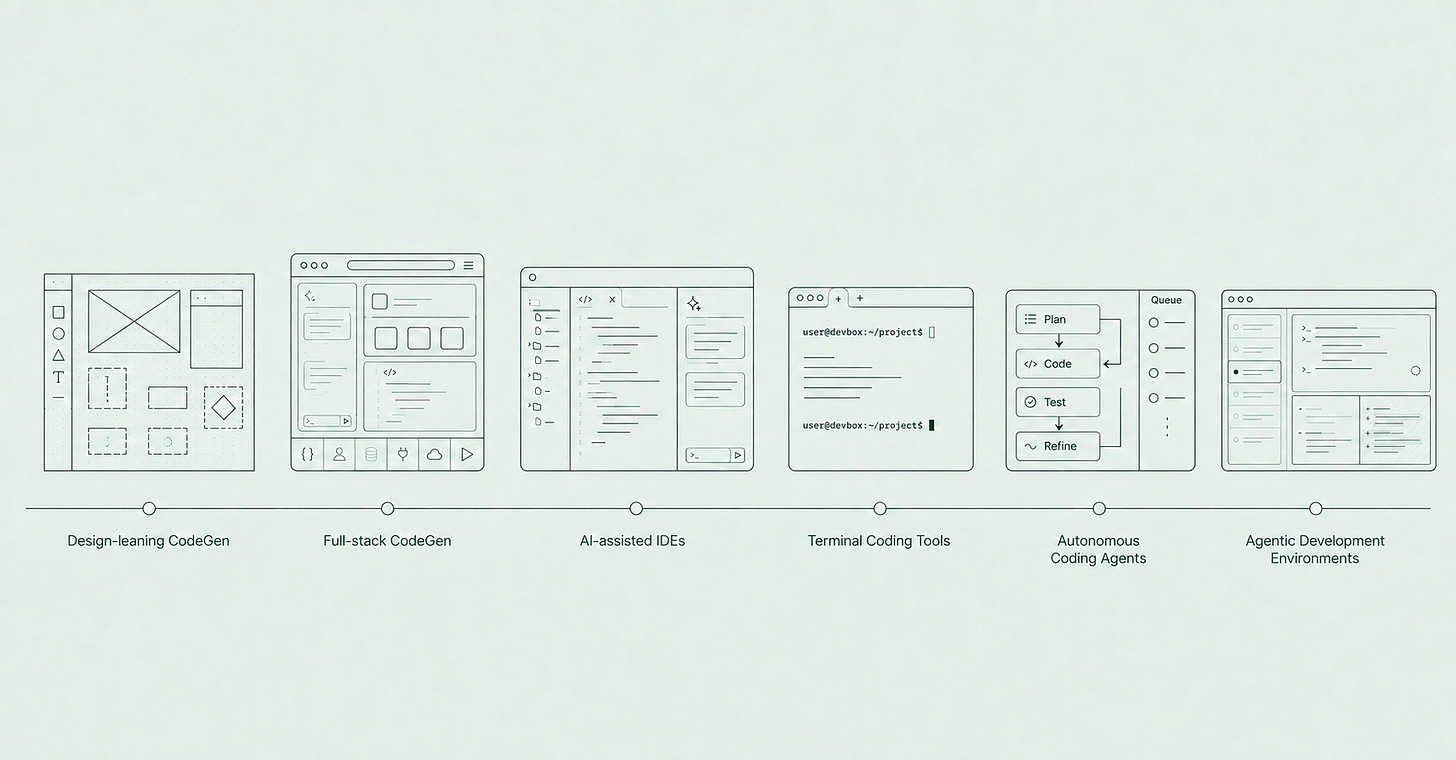
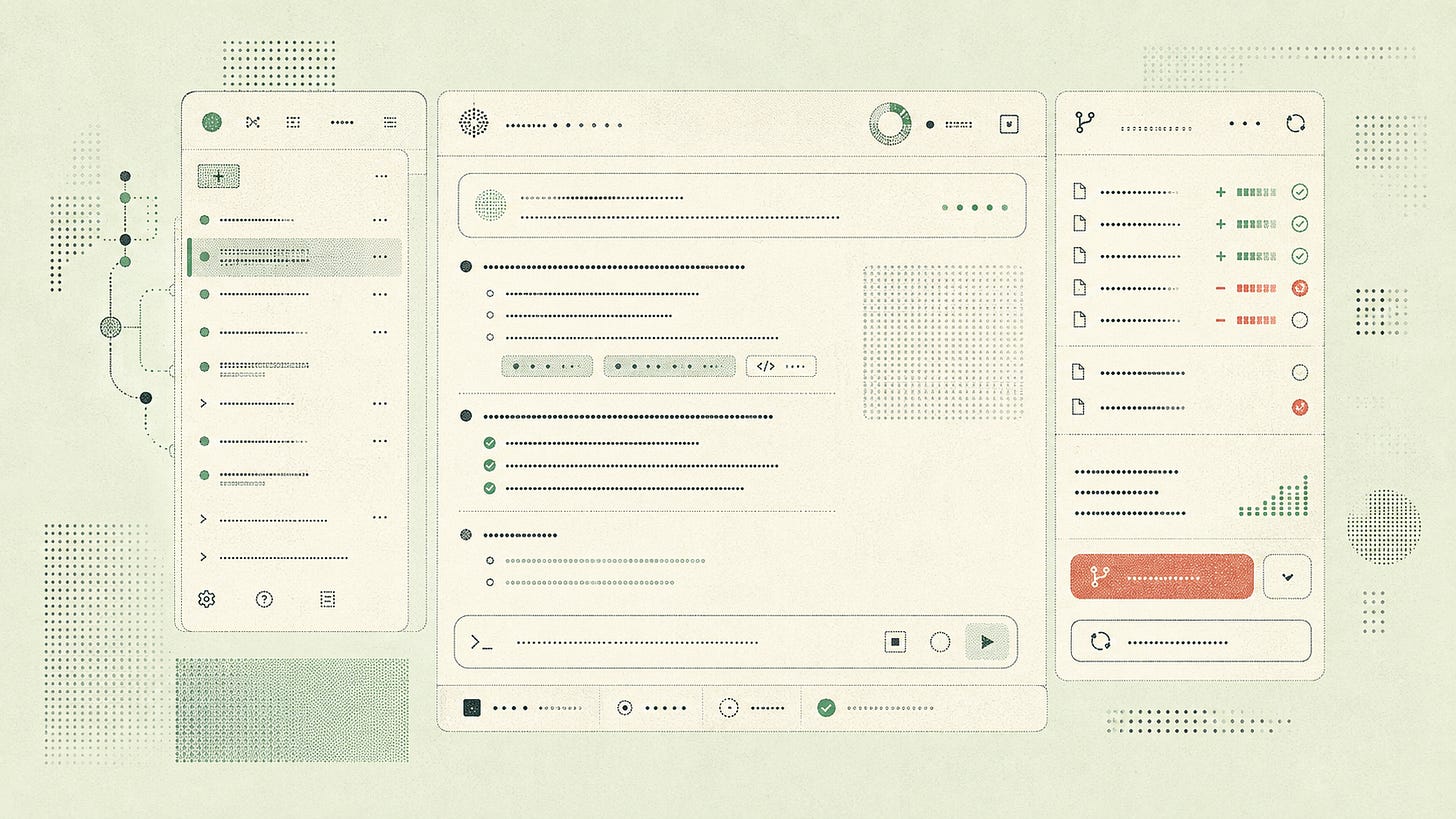
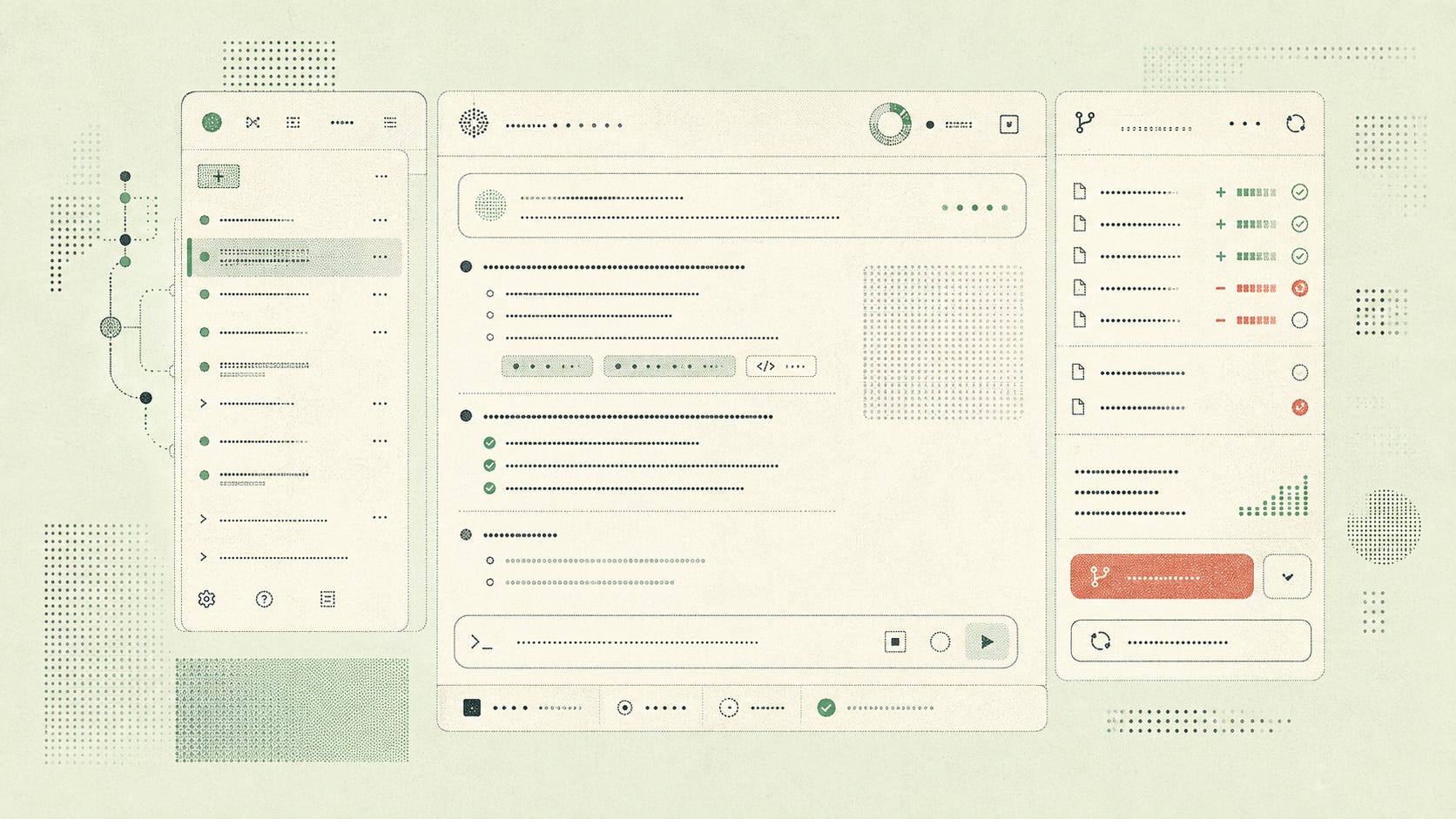
Agentic Development Environments: Task-based orchestration surfaces let builders fan agents out across local and isolated cloud environments, then inspect their progress and artifacts. This is much more abstracted than the usual IDEs, avoiding most of the logistical nightmares that come with starting with IDEs.
Intent tracing: Emerging systems such as Zed’s DeltaDB preserve the conversation alongside the code it produced, making the path from intent to implementation traceable. Because with AI-assisted development, your intents live across chat threads and Skills.
MCP: The Model Context Protocol standardizes how agents connect to external tools, data, and services. That makes integrations more practical. It expands capability. It does not provide safety by itself, but it makes it easier for agents to interact with external services via CLIs that the service providers use to encapsulate their business logic.
The tooling is not making stochastic generation deterministic.
It is making the work more bounded, visible, constrained, and repeatedly evaluated.
Yes, There are Memes That Still Hold, No One Will Defend You From Those
Despite the fact that most of the memes crack me up and I adore some of them for their humor, the parts of many memes that freeze model and harness limitations in time are becoming stale, as we have seen so far.
The ones that poke fun at normies who stumble because they “gave in to the vibes” without foundational literacy, however, still hold.
That is why one consistent theme of mine since I started this Substack has been exploring a more responsible approach to building with AI, particularly Vibe Coding.
Literacy as a guardrail.
Vibe Coding Isn’t the Problem. It’s the Lack of a Baseline.
This post started as a Substack Note and ended up longer than I planned. So here it is.
What type of literacy?
In what form, now that the code is being enveloped in yet another abstraction layer?
Natural language.
How to Actually Start Vibe Coding (The Responsible Way)

Getting Started with Vibe Coding: A 4-Part Series (Non-Techies Edition)
I do not have all the answers yet. My only attempt is to experiment with the platforms and tools and come back with my two cents, along with an assessment of the two cents from those in the arena. If you are interested, check out my Vibe Coding cannon from last year.
The Vibe Coding Canon for Non-Techie Builders (March–September 2025)

I’ve spent over 15 years building digital solutions, and the last five as a consultant helping others shape theirs.
Memes indeed spice up our digital lives in any field or walk of life.
On some occasions, they become more than just memes and end up serving as a wake-up call through their sarcasm. But there comes a time when they become stale.
Now the capability-bound parts of many of the Vibe Coding memes that flooded Reddit and then the other social media platforms following the advent of LLM-powered coding platforms and tools are becoming stale.
That is a good sign.
It indicates that we are nearing a crossing point where Vibe Coding advances beyond the limitations of the very technology that enabled it, paving the way for ordinary users to create software.
This, however, does not mean that Vibe Coding has made it possible to build products that demand complex engineering rigor. Harnesses that went through serious engineering rigor, however, make it possible for anyone who can articulate their intent clearly to build products with some level of production-readiness.
How Far Can Harnesses Take Vibe Coding Toward Production-Grade Outcomes? (With a Focus on Production-Grade Attributes)
“I think it will feel like the next six months is like maybe equivalent to the last two years of model progress,”
Hoang Le said:
“Vibe coding made one layer of engineering faster. Six layers became more important.”

This is to say that Vibe Coding hasn’t solved everything that still demands serious engineering.
You cannot vibe-code a harness. But you can vibe-code a fairly production-grade product using a good harness that has undergone rigorous engineering.
In all this, as I said, it is important to keep in mind that a lot will continue to be disrupted during this “storming phase”, where we still have not figured out the definitive way forward.
Netflix CPTO Elizabeth Stone told Lenny during her recent appearance on his Podcast that we are in the “storming phase” of AI. The “forming phase” is right in front of us, taking shape through the contributions of many.
A phase that is so exciting and bewildering at the same time.
Everyone is exploring.
Some are on a desperate spree to fix what is transitional.
It is important to remember that the “forming phase” is still ahead of us.
No permanent fix is in sight. Everything is in motion.
Nor should we be on a desperate spree to find one.
The models keep swallowing the measurable aspects of software engineering, making parts of the fat scaffolding inside today’s harnesses unnecessary dead weight.
Not the enduring control infrastructure.
Permissions, verification, observability, security boundaries, and accountability remain.
Returning to the memes, the “forming phase” is where I expect more of the remaining capability memes to go stale.
The accountability memes will only lose their teeth if we double down on literacy as much as containment through harnesses and guardrails on the surfaces of the tooling.
No one will defend you from memes that keep roasting you for lacking a mental model of how modern software products get wired at a high level if you do not take the time to learn the fundamentals before you “give in to the vibes”.
This piece is not about defending you from those categories of memes, in case you haven’t paid attention, laughing your ass off at the memes I had dropped here and there.
I expect Vibe Coding to stay and become a dominant way to build with AI.
As a matter of fact, that is already the consensus within the Silicon Valley camp.
No amount of sarcastic memes can stop the evolution.
The ripple effects of harness experiments riding on exponential model improvements attest to that.
The need for the foundational literacies, however, remains.